Author: Lincoln Wang | Founder & CEO, MindsLeap | Partner and CEO, Founders Space China | Founder, MindsLeap Founders AI Club
"When writing software becomes 10x or 100x faster, it is not just product management that becomes the bottleneck. Almost everything becomes the bottleneck."
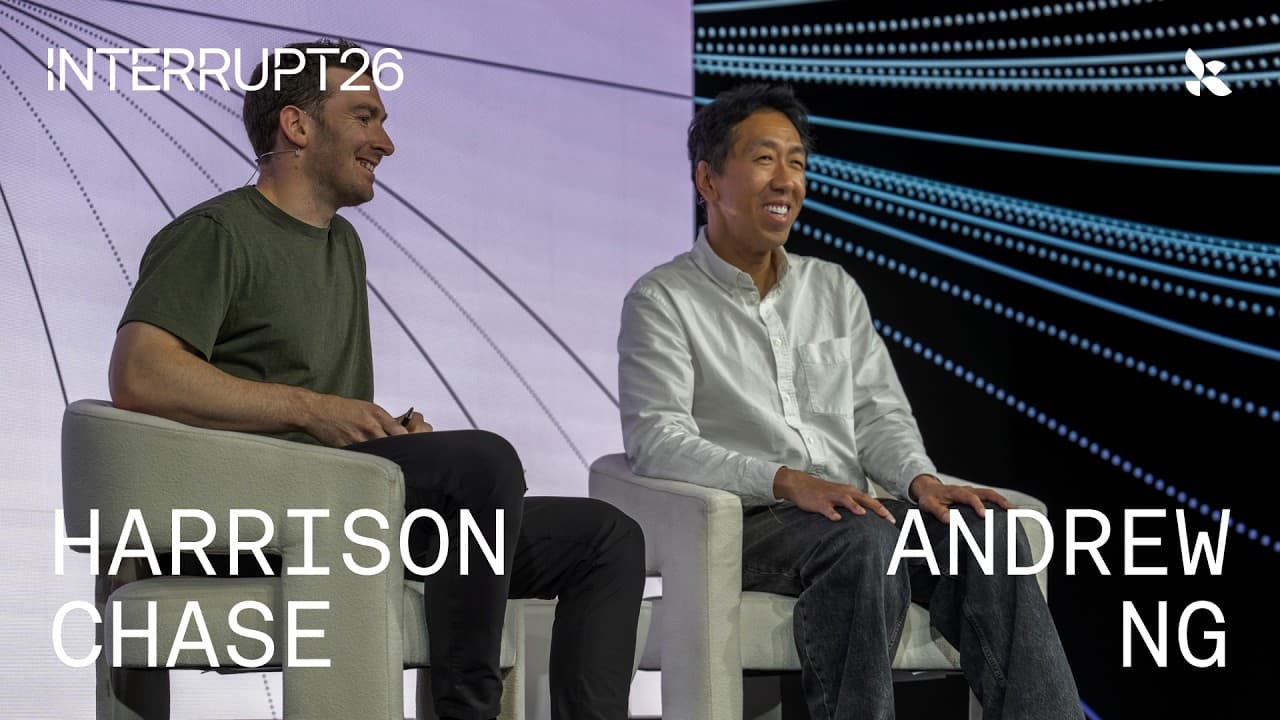
Andrew Ng said this at LangChain's Interrupt 26 conference. It sounds like a problem from a technological utopia, but it points to an organizational earthquake that many Chinese companies are already beginning to feel.
Last year, he wrote about the "product management bottleneck": when software can be built extremely quickly, deciding what to build becomes the limiting factor. A year later, he now thinks that view was too conservative.
Marketing Has to Catch Up with Engineering
Andrew described something happening inside his own teams: because development is moving so fast, marketing teams have to scramble to understand what engineers have built and then figure out how to explain those features to customers.
In the old world, if a product took three months to build, a one-week legal review was reasonable. Now a feature may be built in a day, while legal review still takes a week. Legal review itself becomes the bottleneck.
Design is the same. Every organizational weakness that used to be hidden by long development cycles is now exposed.
This resembles what happens in manufacturing after an automated production line is introduced. The machine gets faster, but if logistics, quality control, and warehousing do not keep up, the entire line just produces unfinished work more quickly.
Two People Doing the Work of Five Functions
Andrew's response is to build very small teams: one to ten engineers, often generalists, with high context and strong autonomy. They run inside broad guardrails, build quickly, ship quickly, and make decisions that would traditionally sit outside engineering.
He gave a concrete example. If a team needs software engineering, product management, terms of service, marketing copy, and design, but only has two people, then by the pigeonhole principle each person must take on more than one role.
"I am not a very good marketer. With AI, I am still not good, just slightly less bad than without AI."
That sounds self-deprecating, but it reveals an important organizational logic. AI is not turning everyone into an expert. It is lowering the threshold for cross-functional work. An engineer can draft the first version of terms of service with AI and hand it to a lawyer for refinement. A product manager can use AI to produce usable marketing copy before the professional team polishes it.
This is not "one person replacing five people." It is "two people can now run through a process that used to require five functions."
From Lego Bricks to Context Centers
Andrew used Lego bricks as a metaphor. If you only have white bricks, the range of things you can build is limited. Add black, yellow, brown, and green bricks, plus some specialized shapes, and the number of possible combinations grows exponentially.
In today's AI ecosystem, the bricks are multiplying: RAG frameworks, agent frameworks, evaluation tools, guardrails, UI components, authentication systems, and databases. The problem is that coding agents do not know all of these new bricks.
Take Nano Banana as an example. When it launched, the knowledge cutoffs of many mainstream models had already passed. Coding agents did not know how to call its API. Some did not even know it existed.
Andrew and Rohit Prasad are working on a project called Context Hub, which can be understood as a Stack Overflow for AI agents. It helps agents access the latest API documentation, SDK information, and feedback on documentation quality.
Andrew said he uses it to load new documentation so coding agents can accurately call APIs whose syntax he does not remember. "This has sped up my coding work a lot."
For companies, this means technology-stack selection and composition are becoming core development capabilities, not just raw coding ability.
Automating One Step Is Not Automation
Andrew's consulting team, AI Aspire, works with large enterprises and financial institutions. He has seen a pattern repeat: almost every company is encouraging bottom-up innovation, letting a thousand flowers bloom.
But the results often do not produce the ROI that CEOs and boards want.
He used a bank loan approval process as an example. A loan process may have five steps: market the loan product, acquire the application, review and approve it, conduct final due diligence, and execute the disbursement. Many teams discover that the middle review step can be automated with AI.
But if only that one step is automated and the steps before and after remain manual, the speed of the whole process does not change in a meaningful way.
The real task is to redesign the entire process. That means asking: who is the customer? What is the value proposition? Which steps can be automated end to end? Which steps require human-machine collaboration?
Bottom-up innovation can create incremental efficiency, which is good. But it does not create transformation. Transformation requires rethinking the process from the starting point.
Preserving Optionality in Uncertainty
Andrew returned several times to one word: optionality.
"I do not know what the leading AI model will be a year from now, and I am not sure what the leading coding agent will be a year from now."
Because of that, he almost never signs contracts longer than one year, no matter how large the discount. A three- or five-year contract at 20 or 30 percent off may look attractive, but a better vendor may appear in a year. Being locked into a long contract means losing opportunity.
He also raised concerns about open source and open-weight models. In recent weeks, there have been signals from the White House about reviewing models before release. Andrew expressed concern about that direction. If anyone tries to wage a war on open source or open-weight models, he believes the world will be wealthier if we protect them, because they help everyone preserve optionality.
For companies, this is an underestimated risk. Binding an entire AI strategy to one closed vendor ecosystem may become a fatal strategic disadvantage within one or two years.
Data Architecture Is About to Be Rebuilt
Andrew ended with a problem almost every enterprise has to face: data architecture.
For the past two decades, companies have invested heavily in organizing structured data: tables, relational databases, and spreadsheets. But AI can now process unstructured data: text, images, PDFs, audio, and video. Delivering the right data to the right AI agent at the right time and place suddenly matters much more.
The recurring problems are fragmentation, lack of governance, data scattered across systems, no unified schema, and permission systems designed for humans rather than agents.
Andrew said he has looked at many vendors working on unstructured data, but has not yet found one he is truly satisfied with. He predicts that many enterprises will launch data-architecture reconstruction projects worth tens or even hundreds of millions of dollars in the coming years.
He also shared a personal preference. During rapid iteration and prototyping, he uses NoSQL databases such as MongoDB heavily because data can be written immediately and schema can be determined at read time, without constant database migrations. NoSQL does not always scale to the largest production workloads, he said, but its scalability is stronger than many people realize. Large production systems may still return to relational databases eventually.
Speed Exposes Organizational Gaps
The core judgment from Andrew's conversation can be summarized in one sentence: the speed of AI coding agents does not expose a company's technical gap first. It exposes the organizational gap.
Coding becomes 10x or 100x faster, but product definition cannot keep up, marketing cannot keep up, legal cannot keep up, and data cannot keep up. These constraints used to be hidden by slow development cycles. Now they are all visible.
For Chinese entrepreneurs, this means several things. Organizations need to move toward smaller, more complete teams. Generalists become more valuable. Processes need to be redesigned end to end, rather than filled with AI tools inside old workflows. Technology choices must preserve optionality instead of locking the company into uncertainty. Data architecture is not an IT issue. It is an enterprise-level strategic issue.
When software development is no longer the bottleneck, the company's real bottlenecks finally begin to show.
Source Note
This article was interpreted by Lincoln based on LangChain's official video The Future of AI Agents with Andrew Ng | Interrupt 26, published on June 17, 2026.
About MindsLeap
MindsLeap is an AI transformation accelerator that helps traditional entrepreneurs find transformation paths in the AI era. In partnership with Silicon Valley incubator Founders Space, MindsLeap connects technology founders with real customers and scenarios, links domestic and international capital with the Silicon Valley technology ecosystem, and supports China's industrial AI transformation and global expansion.
This article was translated and adapted from the Chinese original with AI assistance.