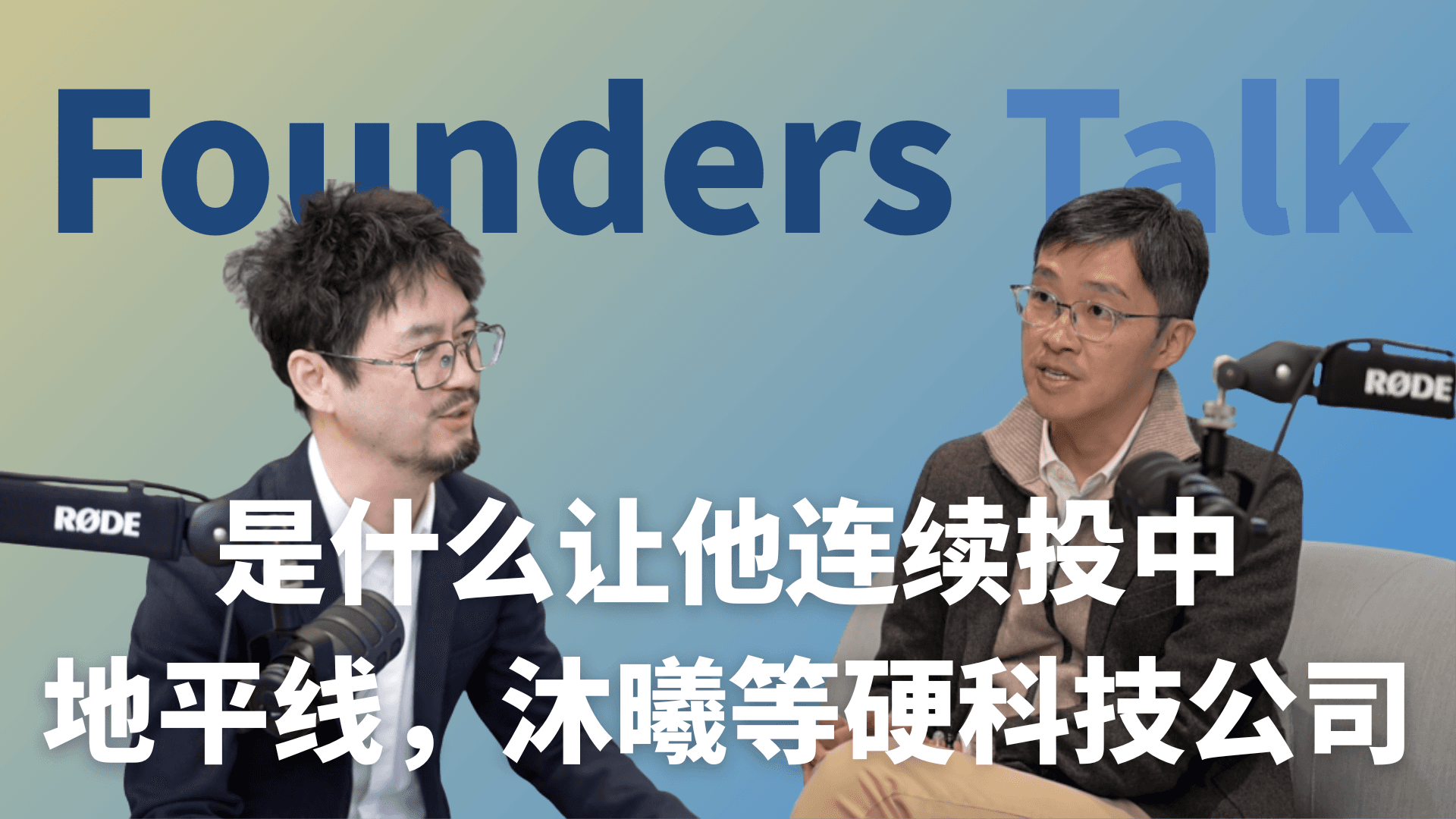
Author: Lincoln Wang | Founder & CEO, MindsLeap | Partner and CEO, Founders Space China | Founder, MindsLeap Founders AI Club
When people talk about AI and hard technology, they often separate the world into two roles.
One group evaluates sectors, technology windows, and portfolios from the capital side. The other lives on the front line of entrepreneurship, facing cash pressure, product pivots, and organizational tension.
Andy Zhang stands on both sides.
As founding partner of Hexuan Capital, he has long focused on hard technology, AI, and new energy, with exposure to companies such as Horizon Robotics, Innovusion, and WeLion New Energy. At the same time, he is also the founder of GOFA AI, an AI startup that has experienced multiple product pivots and the very real pressure of building a company.
In our recent conversation, what interested me most was not simply which sectors are worth investing in. It was this question:
When someone is both investor and entrepreneur, how does that change the way he understands industries, technology, and organizations?
Why Hard Technology, Not Just the Hottest Trend?
I first asked Andy why Hexuan Capital chose to focus on hard technology early, rather than chasing lighter and seemingly faster-growing sectors.
His answer was simple but important. Hexuan did not build its strategy around whatever looked hottest at the moment. Instead, it chose areas where the team could build durable understanding over time. For them, hard technology, AI, and new energy are not short-term themes. They are long-cycle domains where accumulated insight matters.
This reflects an important investment principle:
The most penetrating investors are often not the ones who cover everything. They are the ones who stay long enough in areas they truly understand.
Hard technology opportunities rarely mature because of one market cycle. They require sustained understanding of technology pathways, supply chain structure, engineering difficulty, and commercialization timing. Compared with chasing trends, this is closer to long-term research and long-term companionship.
Looking at the Whole Chain, Not a Single Product
When Andy described Hexuan’s investment approach, he emphasized that the team does not look only at isolated technologies. Instead, they study a forming industrial direction and examine the upstream, downstream, and key components around it.
In new energy and intelligent vehicles, for example, the focus is not simply on electric cars as an end product. The team studies the systems that enable the industry to scale:
- Whether battery systems are entering a new stage
- Whether sensors and lidar can support stronger perception
- Whether automotive chips can provide greater computing power and stability
- Whether new power units can extend into broader robotics scenarios
This perspective matters because many people still understand opportunities only by looking at final product categories. But high-value opportunities often emerge when the supply chain is being rebuilt, key components are maturing, and system capabilities are beginning to connect.
In solid-state batteries, for example, Andy is less interested in concept hype than in whether the technology truly solves safety and extreme-environment challenges. In intelligent vehicles, chips, lidar, and batteries are not isolated projects. They are infrastructure for the next stage of scaling.
That is why his question is often not “Will this happen?” but “When will this cross the critical threshold?”
GOFA AI: Startups Grow Through Pivots, Not Perfect Plans
Andy’s reflections on his own entrepreneurial journey were especially revealing.
GOFA AI did not begin as the company people see today. It started from an idea closer to intelligent earphones. As the market environment, product judgment, and team capabilities changed, the company went through multiple pivots and ultimately became very different from its original plan.
The key lesson is not any single pivot. It is Andy’s broader conclusion:
A startup is not executed according to a perfect business plan. It grows through adjustment, trial and error, collisions, and moments that feel close to losing control.
He spoke openly about the ups and downs of entrepreneurship, including moments when cash on hand could support the company for only a short period. That kind of detail matters because it reveals what polished startup stories often hide.
Outside observers see fundraising, product launches, growth, and valuation. Inside the company, what founders feel is uncertainty, constant correction, and the pressure of making the next decision with incomplete information.
That is also why an investor who has personally built a startup often evaluates founders differently from someone who only looks at a financial model.
The Value of Being Both Investor and Entrepreneur
I asked Andy what the dual identity gives him.
As an investor, he can better understand the real pressure founders face. He understands why founders hesitate, why they get stuck, and why they sometimes make decisions that look irrational from the outside. These are not abstract concepts to him. They are lived experience.
As an entrepreneur, he also understands what capital wants to see: what narrative, what validation, what growth signal, and what proof points matter.
But the deeper value is not knowing the language of both sides. It is having to live in the gap between what founders want to build and what investors need to believe.
This is a tension many AI startups face today. Markets want certainty, while entrepreneurship is inherently uncertain. Capital wants a clear path, while many promising technology companies do not grow linearly in the early stage.
Someone who understands both roles may not have an easier life. But he may see the real tension more clearly.
Positioning Before Industry Scale
Another point I found especially valuable was how Hexuan identifies opportunities before a sector truly scales.
Andy’s answer was not mysterious. It came down to sustained internal debate, constant discussion of technology trends, and close observation of which variables are approaching critical thresholds.
This points to a practical framework.
Many technologies look immature in the early stage. Many markets look small before they break out. The best opportunities often appear not after everything has been proven, but in the stage just before scale.
That stage often has several features:
- The technology path is becoming clearer
- Cost or engineering challenges are showing signs of resolution
- Key supply-chain nodes are being completed
- Market perception has not yet caught up with real progress
If an institution enters only after everyone understands the opportunity, the best window may already be gone. If it enters too early without deep understanding, it may only be betting on a concept. The art is judging the threshold.
Three Practical Takeaways
From this conversation, I see three lessons for entrepreneurs and investors working in AI, hard technology, and industrial innovation.
1. Start with what you truly understand
Long-term thinking is not a slogan. It requires deep, sustained understanding of a domain. Only then can you move through cycles of hype and skepticism.
2. Look beyond the product to the underlying infrastructure
From batteries and chips to perception systems, what determines whether an industry can scale is often not the visible application, but whether the underlying capabilities are maturing together.
3. The rare bridge between founders and capital is realistic empathy
Understanding why founders suffer, why investors hesitate, and how survival and growth trade off against each other will become increasingly important in AI and hard-tech entrepreneurship.
Final Thoughts
My conversation with Andy strengthened one belief: when discussing AI and hard technology, we should not only ask whether a sector is hot. We should ask who is willing to stay inside complex problems long enough to understand them.
Andy’s most interesting quality is not only the projects he has invested in, or the fact that he is both investor and founder. It is that he continues to stand in the difficult, slow, and uncertain zones of industrial change.
In those zones, hype matters less. What matters is whether you can understand the rhythm of technology evolution, withstand uncertainty, and build your own judgment before the market fully catches up.
That may be why people who position themselves before industry scale are often not the best trend chasers. They are the ones willing to dig deeply for a long time.
About MindsLeap
MindsLeap is an enterprise AI transformation and AI-native startup acceleration platform. Through the MindsLeap Founders AI Club, AI training and strategic advisory, FDE implementation, startup acceleration, and global growth services, MindsLeap helps traditional enterprises embed AI into real business workflows and helps AI-native ventures connect with industry use cases and global markets. MindsLeap is a global partner of Founders Space.
This article was translated and adapted from the Chinese original with AI assistance.