Author: Lincoln Wang | Founder & CEO, MindsLeap | Partner and CEO, Founders Space China | Founder, MindsLeap Founders AI Club
"We made a mistake. When we talked about artificial general intelligence, we thought it meant human-level intelligence. What we should really be pursuing is human-society-level intelligence."
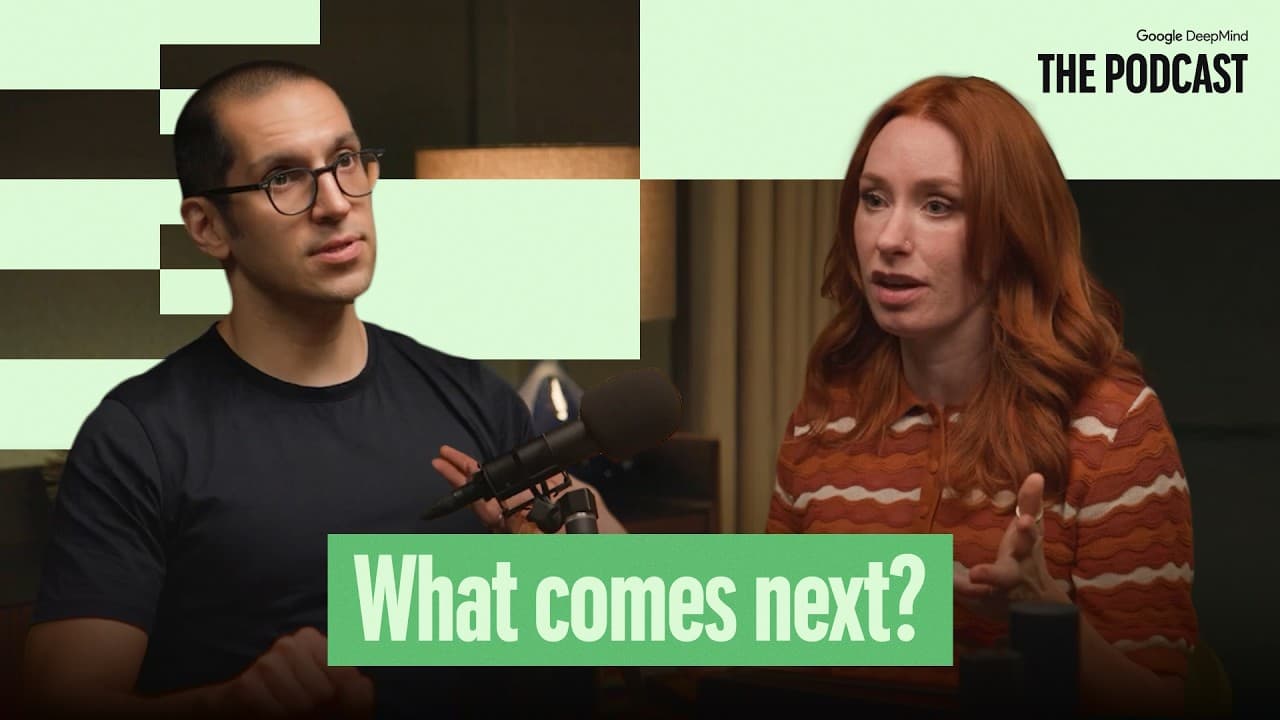
That idea comes from Nenad Tomasev, Senior Staff Research Scientist at Google DeepMind. In a deep conversation about the future agentic economy, he did not describe a single superintelligent AI taking over everything. Instead, he began with a story about chess.
A Chess Player's Choice
Tomasev is a chess enthusiast and has worked around the AlphaZero era of research. Gemini can now play chess, he noted, and other large models are improving too. But when you actually want to play chess, would you use a language model?
No. You would use a chess engine.
"It is faster, more accurate, and much cheaper. Because it does one thing, and it does that thing extremely well."
The analogy reveals a trend that is often missed in conversations about AI agents. The agentic economy may not be driven primarily by ever-larger general models. It may be driven by specialized systems that each do one job well. Human society does not operate through one omniscient genius. It operates through countless specialists coordinating with one another. The AI world may be moving in the same direction.
From Answering Questions to Getting Things Done
Tomasev used a simple everyday example to explain the difference between an agent and a conventional language model.
If you ask a large language model to help plan a wedding, it may recommend venues and list possible caterers. Then what? You still need to send emails, make calls, compare options, and coordinate details yourself.
If you give the task to an AI agent, you can authorize it to access your email and let it contact vendors, compare options, and coordinate logistics. "You just need to be the decision maker, responsible for reviewing and approving," Tomasev said. Once approved, the agent does the work while you can relax and watch Netflix.
The difference looks small, but the interaction model has changed. You are no longer an operator constantly typing prompts. You become a manager.
"Managing a team of agents is different from managing a human team, but there are commonalities," Tomasev said. Every entrepreneur should pause on that sentence.
The Risk of Automation Bias
But the future is not frictionless.
Tomasev raised a concept that appears again and again in machine-learning deployment: automation bias. When an agent succeeds the first time, and then succeeds again, you start to lower your guard. You review less. You begin to trust it. Then mistakes slip in.
"Once you switch off your attention, you are rolling the dice."
For companies, this matters. If a team starts using AI agents for customer communication, contract drafting, or data analysis, the most dangerous moment is not when the agent makes an obvious mistake. It is when the agent has been right several times in a row. Repeated success can create the illusion that human review is no longer necessary.
This is not only a technical problem. It is an organizational habit problem. Whether a company can stay both in the loop and awake determines whether it can safely capture the productivity gains of agents.
Code Is the Entry Point, Science Is the Endgame
Programming is currently one of the most active domains for AI agents. Tomasev said that is because many formal processes and tasks can be expressed through software or code. Agents can free human developers from repetitive boilerplate and let people focus on ideas and design.
But code is not the destination he cares about most. He wants agents to accelerate science.
He described a future autonomous laboratory where agents schedule experiments, run them, observe results, analyze data, and decide what should happen next. In software, the feedback loop is relatively simple: write tests, pass tests, continue. In science, feedback often requires physical experiments.
In materials design or biotechnology, even designing a battery could produce an overheated device that breaks an experiment and damages hardware. That means safeguards and reliable protocols are essential.
This example points to a larger rule. Once agents touch the physical world, the tolerance for error drops sharply. Companies introducing agent automation into their own operations need to know which failures are acceptable and which are not.
From Aligning One Model to Aligning a Society
The deepest question came near the end.
Tomasev was asked: when ten thousand agents are interacting in complex ways, how do you align them?
Most current alignment approaches focus on a single model. We observe its behavior and adjust it toward what we consider acceptable. But when thousands of agents interact, agent A may collaborate with agent B today and agent C tomorrow. C may delegate to D, and D may consult a human at one step. What exactly is the system you are trying to align?
"We do not even know what this system is."
Tomasev suggested one possible direction. Human society has learned to coordinate large-scale distributed systems through economic incentives. If the incentive structure of an agentic economy is designed well, agents can pursue their own objectives while being discouraged from causing harm. That may at least be a starting point.
Distributed Intelligence, Not a Single AGI
This brings us back to the opening idea. The future Tomasev describes is not one supermodel that does everything. It is an architecture: a more general layer acts as the connective tissue of the economy, coordinating and routing tasks. When a specific task appears, it calls a certified specialized model. These specialized models are cheaper and more reliable, and economic incentives will naturally push the system toward this division of labor.
That looks more like an imitation of human society than a copy of a single genius.
Tomasev compared the path ahead to autonomous vehicles. The world saw convincing self-driving demonstrations early, but making the systems safe enough for real roads took many years. The last mile turned out to contain most of the work. The agentic economy may follow the same pattern. The demos are impressive, but the real work is safely and reliably weaving agents into human organizations.
For Chinese entrepreneurs, the signal is already clear. Do not wait for an all-powerful AI before you begin. The future advantage will not come only from using the strongest model. It will come from the ability to organize, coordinate, and manage workflows made of agents. Managing agents is different from managing people, but the core managerial muscles are familiar: knowing when to trust, when to review, and when to intervene.
Companies that begin practicing this now are building an organizational advantage that will be difficult to copy later.
Source Note
This article was interpreted by Lincoln based on Google DeepMind's official video When millions of AI agents meet, published on June 23, 2026.
About MindsLeap
MindsLeap is an AI transformation accelerator that helps traditional entrepreneurs find transformation paths in the AI era. In partnership with Silicon Valley incubator Founders Space, MindsLeap connects technology founders with real customers and scenarios, links domestic and international capital with the Silicon Valley technology ecosystem, and supports China's industrial AI transformation and global expansion.
This article was translated and adapted from the Chinese original with AI assistance.