Author: Lincoln Wang | Founder & CEO, MindsLeap | Partner and CEO, Founders Space China | Founder, MindsLeap Founders AI Club
"If you break down the economic gains of the past thirty years, the vast majority came from software companies. Take software companies out of the Nasdaq and S&P entirely, and what's left is a flat line."
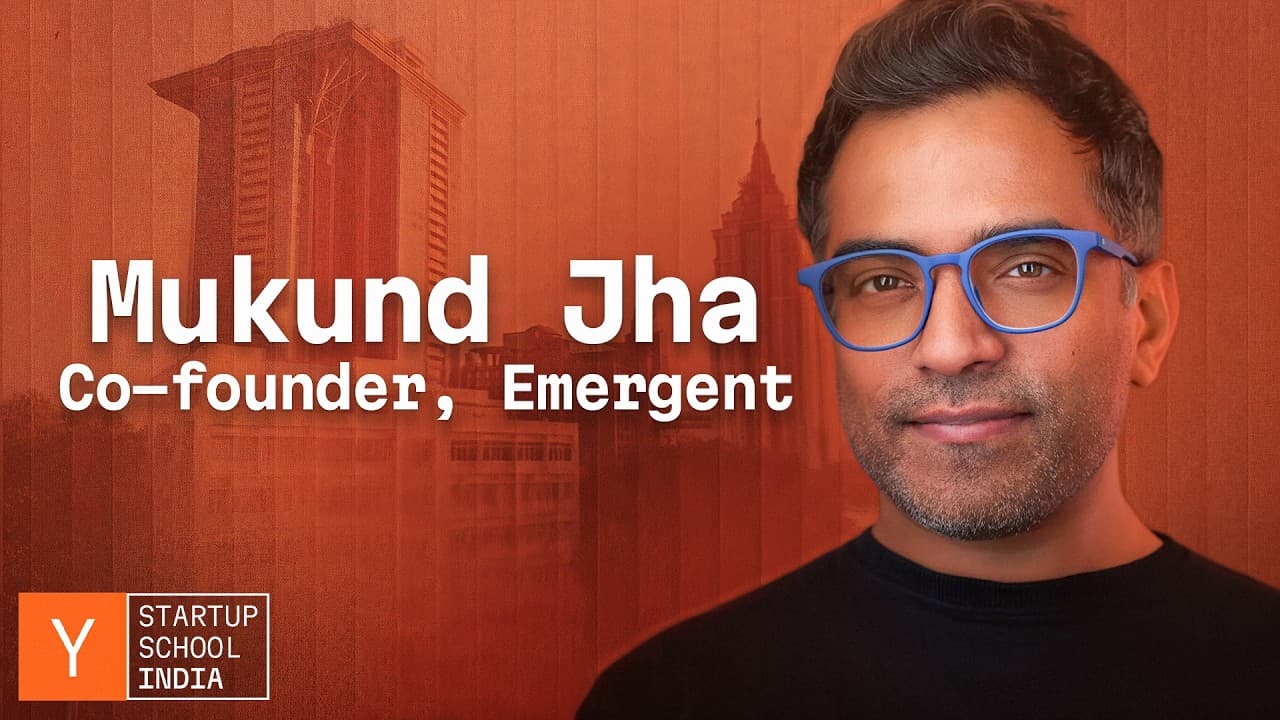
The person who said this is Mukund, founder of Indian AI company Emergent. In June 2026, Y Combinator held an event in India. He sat on stage sharing an unconventional startup path: product went live 9 months ago, now at 8.5 million users, 10 million apps, $100 million annualized revenue.
Even more unusual: before actually launching their product externally, the company did one thing first — took a 4-person team to first place in the global benchmark for coding AI agents.
Be World Number One First, Then Decide What to Sell
In 2023, after leaving the delivery company Dunzo he founded, Mukund and his twin brother Maddav built a 4-person team targeting coding AI agents. They didn't first think about product form or find customers — they set their sights on a coding benchmark called SWE-bench.
"We spent 3 months攻克ing that benchmark and got to world number one," he said. "But that really laid the foundation for Emergent."
This sentence deserves a pause. Most startup paths are: find demand first, build product, then iterate. Emergent's path was: push technology to its极限 first, then with that confidence look back and ask: if coding becomes easy for everyone, what happens to the world?
This isn't accidental. Mukund was the youngest on Google's search ranking team, when internal resistance to machine learning was strong. He kept asking "why not use machine learning," ultimately driving a major transformation in search ranking. His habit: first find a number that quantifies progress, pin yourself to it, then decide how to tell the story.
From WhatsApp Group to Global Platform
Mukund's startup intuition came from a very personal scenario.
In 2014, after leaving Google and moving to Bangalore, he found too many trivial things to handle in daily life — car maintenance, gas connection, utility hookups. He thought there must be a simpler way, so he built a WhatsApp group, shared the number with friends: "Say what you need in the group, we'll handle it."
This WhatsApp group became Dunzo. At peak, nearly 1 million riders on the ground, processing 10 million orders monthly, connecting 5,000 stores. Dunzo became one of India's instant delivery pioneers — "Dunzo it" even became a verb in India.
He developed a habit at Dunzo: personally delivering in the early days. "I had a motorcycle and a car — at night when orders came in, I'd jump on and deliver myself," he said. "Doing things that don't scale early on really helps you stay close to customers, understand real pain points."
This habit was carried directly into Emergent.
Emergent's operations carried the same "war room" DNA. They monitor every app being built on the platform — if something breaks, they flag it immediately. That Watchtower team from Dunzo days watching every single order became Emergent's product discipline.
Others Do Demos, You Ship Product
Emergent wasn't the first to do AI website builders. Mukund admits this.
But when he looked at existing products, he found a structural gap: "Most platforms focus mainly on frontend and demos. But what users really want is shippable software."
"Users have an expectation — my software should actually run. Most solutions are good at helping you start, but terrible at helping you finish. You don't get working software from those platforms, no real backend, no actual database connections."
This judgment became Emergent's product watershed. They didn't stack features on existing product logic — they rebuilt from the full software engineering chain.
"We built almost everything from scratch. When we ran the same prompts across all platforms, we were far ahead of everyone in the market."
This isn't a feature race — it's a completion race. While most AI coding tools were still at generating frontend pages, Emergent packaged backend, database, deployment, and operations all in. Users don't need to understand programming — just talk to the AI agent, and the platform takes over.
Turning Growth into a Math Problem
With a product, how do you get more people to know about it? Mukund used a very engineering-driven method.
"We turned growth into a math problem — how many social media views needed, how many impressions, how many clicks, how many converting users. At that point, we knew influencer marketing was a good strategy for us."
This thinking essentially grew from engineering mindset. First figure out the funnel model, find the channel with highest conversion rate, then concentrate resources. No need for flashiness, not much trial and error — just get the numbers right, then scale.
This is also why a company headquartered in Bangalore with 95% of its team in India draws most revenue from US and European markets, with India only 10%. They positioned themselves in global competition from day one, rather than doing local first then going overseas.
Doing Harder Things Makes It Easier to Recruit Good People
Mukund mentioned a counterintuitive observation: "Being an Indian local company and being a global company takes the same effort. So my advice is: think global from day one."
Behind this is a deeper logic. When asked why Emergent's team moves so fast, his answer was hiring standards.
"We look for learning slope in hiring — people passionate about solving problems. What separates us from other companies now is everyone in the company genuinely enjoys using AI to solve daily problems."
When a company chooses to tackle harder problems, it's also筛选ing more suitable people. Simple problems attract executors; hard problems attract builders. In the AI era, this choice matters more than ever.
Attack the Ceiling, Not the Floor
Mukund's final message to entrepreneurs: "No matter how big your current idea is, multiply it by 10x, 100x. In the AI era, this isn't the time to attack the floor — it's the time to attack the ceiling. Think bigger, and your probability of success actually increases."
From WhatsApp group to Dunzo, from 4-person benchmark team to $100M revenue in 9 months, Mukund's trajectory sends a clear signal: technology gaps are never the decisive factor. What's decisive is choosing what height to think from at the start, and what organizational discipline turns that height into reality.
For Chinese entrepreneurs observing the AI wave, Emergent's story isn't saying "how powerful AI is" — it's saying: when facing an industry being reshaped, being a latecomer isn't necessarily a disadvantage —前提 you're willing to do the hardest part first, then enter the market with a finished product mindset.
About MindsLeap
MindsLeap is an AI-native organization transformation accelerator.
In deep partnership with Silicon Valley innovation incubator Founders Space, we continuously connect cutting-edge global AI insights, the Silicon Valley tech entrepreneurship ecosystem, and real transformation scenarios for Chinese entrepreneurs.
This article was translated and adapted from the Chinese original with AI assistance.