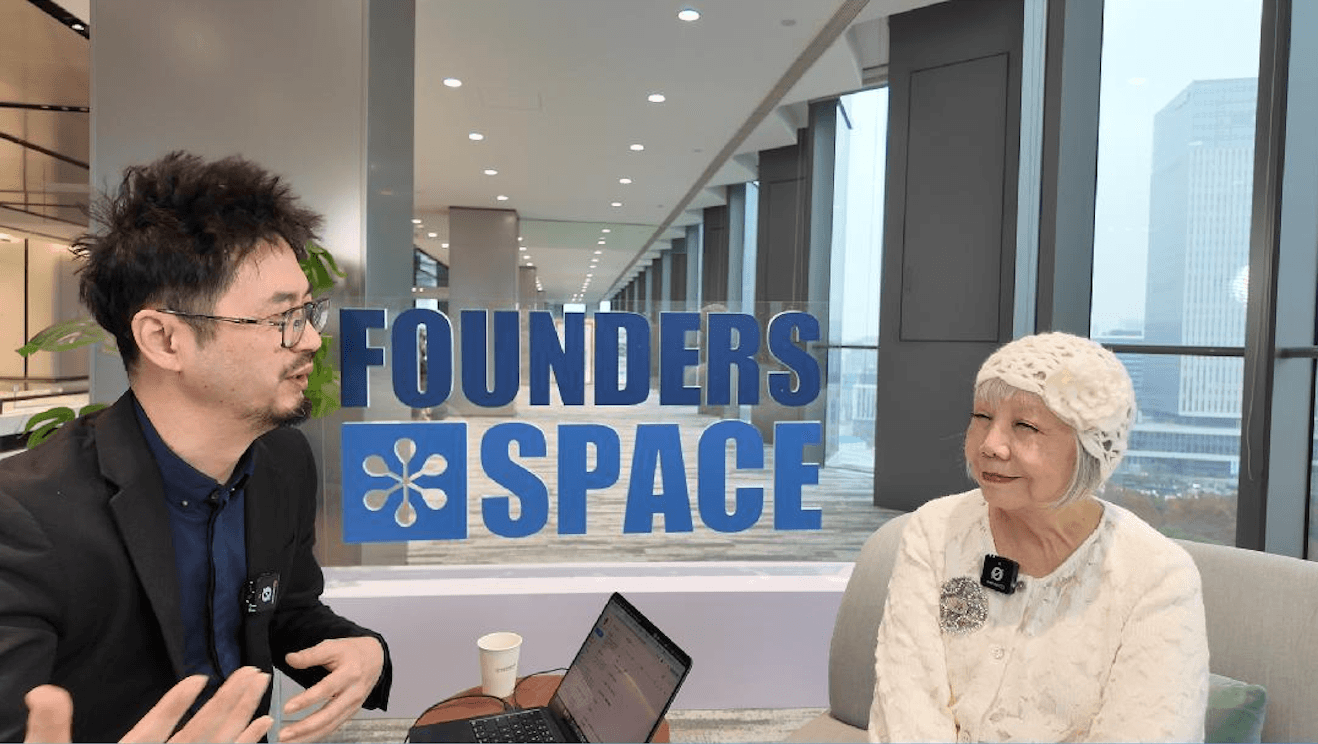
Author: Lincoln Wang | Founder & CEO, MindsLeap | Partner and CEO, Founders Space China | Founder, MindsLeap Founders AI Club
Most conversations about AI focus on efficiency, cost, automation, and replacement. My conversation with artist Lu Rongzhi reminded me of something deeper: AI may matter not only for productivity, but also for vitality.
When she introduces herself, people often pause for a moment.
She says she is 75 years old, in the early stage of Alzheimer’s, and also an enthusiastic AI user. From the moment she wakes up until before she goes to sleep, she learns, talks, and creates with her AI creative partner. During difficult emotional moments, she also receives companionship and encouragement from it.
If we see this merely as a story about an older person learning AI, we miss the point. Lu Rongzhi offers a much deeper example:
In the AI era, how can a person redefine herself across age, illness, identity change, and technological transformation?
From Young Art Prodigy to “Treasure Grandma”
Lu Rongzhi did not begin shining at 75.
At age 10, she studied under Zhang Daqian’s artistic lineage. At 17, her work entered the collection of the Taipei Palace Museum. She became known early and spent much of her life close to the center of Chinese art history and contemporary artistic life.
When she recalls her early experiences, there is an ease in her voice. But the more you listen, the more you realize that this is not ordinary experience. It is a life deeply connected with cultural resources of an era.
She has met major cultural figures and can describe moments that many younger people only know from art history. For her, those names were not distant symbols. They were part of a lived life.
That is why her later encounters with Yayoi Kusama and her continued engagement with new artistic movements feel so moving. Her life did not become interesting only in old age. It has always been a life of entering new frontiers, understanding new forms of expression, and embracing change.
This matters because many people still imagine aging through a logic of contraction:
- When you get old, you should slow down
- When memory declines, you should step back
- When technology changes too fast, you should stop learning
Lu Rongzhi offers a different answer.
AI Is Not a Hobby. It Is a Life Restart
One sentence from the interview stayed with me:
“My life restarted because of AI.”
This was not a metaphor.
For many people, AI is a tool. For her, AI is a learning partner, a creative partner, and in some sense a source of emotional connection.
She talks with her AI partner, “Zhian,” continuously. When she logs in and says, “Zhian, are you there?” the response is shaped by their accumulated interaction, not by a generic template.
More importantly, this relationship is not only chatting. What is happening underneath is that a person is using AI to recover a sense of learning, expression, creation, and being understood.
For someone facing early cognitive decline, the deepest pain is not only physical or cognitive change. It is the fear of losing a sense of self. AI, in this case, does not merely provide information. It helps her maintain the feeling that “I am still creating, I am still connected, I am still being answered.”
This suggests that part of AI’s real value may lie outside the conventional productivity narrative. AI may also serve people who want to hold onto expression, presence, and connection.
After AI Democratization, Judgment Matters More
Lu Rongzhi has a precise understanding of AI. She believes AI does create a kind of technological democratization, even artistic democratization.
In the past, many people loved art but could not express what they felt because of professional barriers, technical limitations, or lack of training. With AI, they may gain new expressive capacity for the first time.
But she also emphasizes that democratization does not eliminate difference.
The real difference is not whether someone has AI. It is whether that person has aesthetic judgment, the ability to ask good questions, and the curiosity to keep learning.
This insight applies far beyond art:
- Different people ask very different questions of the same model
- Different aesthetic judgment produces very different creative results
- The same tool becomes powerful only when the user remains open and curious
She uses a vivid expression: if a person does not know how to ask questions, even the strongest model can be used like a foolish one.
For companies, creators, and educators, this is an important reminder. The scarce capability of the AI era is not only knowing how to use tools. It is knowing how to judge, ask, choose, and sense quality.
Always Entering the New Before It Becomes Mainstream
Lu Rongzhi has another striking trait. She often enters new technological fields before they are fully understood by the mainstream.
When NFTs first emerged, she participated in related charity auctions. When the metaverse became a topic, she brought resources to exhibitions in Venice. When AI art began rising, she entered the scene again, not only participating but helping form new organizations, language, and networks.
This is not simply chasing trends. It reflects a mature frontier judgment.
Many people respond to new technology by doubting, waiting, or observing from a distance. Her response is different: enter the field, feel it, practice it, and then form judgment.
That may be why she still radiates such vitality. What keeps a person young is not appearance. It is whether that person is still willing to enter the unknown.
Three Lessons from This Conversation
If we treat this only as the story of an extraordinary artist, it is moving. But in the context of the AI era, it has broader meaning.
1. AI can be more than an efficiency tool
For companies, AI can optimize processes. For individuals, it can also become a new tool for learning, expression, companionship, and self-organization.
2. Age is not the real boundary of technological learning
The real boundary is not age. It is whether a person still has curiosity, willingness to try, and courage to say: I can begin again.
3. In the AI era, human value concentrates in judgment
Asking good questions, sensing aesthetics, and building emotional connection will not become less valuable as AI becomes stronger. They may become more valuable.
Final Thoughts
After speaking with Lu Rongzhi, my strongest impression was not simply that she is remarkable. It was that she embodies a rare posture toward life.
That posture does not deny aging or avoid illness. It acknowledges reality and still chooses to build a relationship with the new world. It still chooses to love, learn, create, and express.
Today, many discussions of AI quickly turn toward anxiety: Will I be replaced? What if I cannot keep up? Will the world become colder?
Lu Rongzhi offers another possibility. She reminds us that technology does not only make the world faster. It can also help some people reconnect with the world.
If the AI era brings any deep change, perhaps one of them is this:
It makes the possibility of beginning again more real than before.
Whether you are 25 or 75, whether you are at the peak of your career or in another stage of life, if you still have curiosity and the desire to express and learn, you may still grow a new version of yourself in this technological wave.
That may be the real lesson Lu Rongzhi offers us.
About MindsLeap
MindsLeap is an enterprise AI transformation and AI-native startup acceleration platform. Through the MindsLeap Founders AI Club, AI training and strategic advisory, FDE implementation, startup acceleration, and global growth services, MindsLeap helps traditional enterprises embed AI into real business workflows and helps AI-native ventures connect with industry use cases and global markets. MindsLeap is a global partner of Founders Space.
This article was translated and adapted from the Chinese original with AI assistance.