Author: Lincoln Wang | Founder & CEO, MindsLeap | Partner and CEO, Founders Space China | Founder, MindsLeap Founders AI Club
In the last week of March 2026, something interesting happened in China’s enterprise collaboration software market. Feishu, DingTalk, and WeCom all released or open-sourced command-line interface tools within the same week.
This was not a coincidence. These companies were answering the same question: the next major user of software may not be a human being. It may be an AI agent.
What Is a CLI, and Why Does It Matter?
Most software we use today is built around a GUI, or graphical user interface. Buttons, menus, windows, icons, and visual flows are designed for human eyes and hands.
A CLI, or command-line interface, works very differently. It is text-based. You type a command, and the software returns a result in text. For humans, this can feel less intuitive. For AI agents, it is often much more natural.
For example, if a human wants to send a message in a collaboration app, the process might be: open the app, find the group, click the input box, type, and send.
For an AI agent, the equivalent could be one structured command:
lark-cli im send --chat "Product Team" --text "The weekly report has been updated"
GUI is intuitive for humans. CLI is native for agents: text in, text out, precise, automatable, and easy to compose.
That is why software is becoming more CLI-friendly. It is not that human interfaces are disappearing. It is that software now needs a second interface layer for machine users.
CLI-Anything: Turning Software into Agent-Native Tools
To understand how deep this shift could become, look at CLI-Anything, an open-source project from the HKU Data Intelligence Lab.
Its slogan is “Making ALL Software Agent-Native.” The project analyzes open-source software and automatically generates command-line interfaces that AI agents can use.
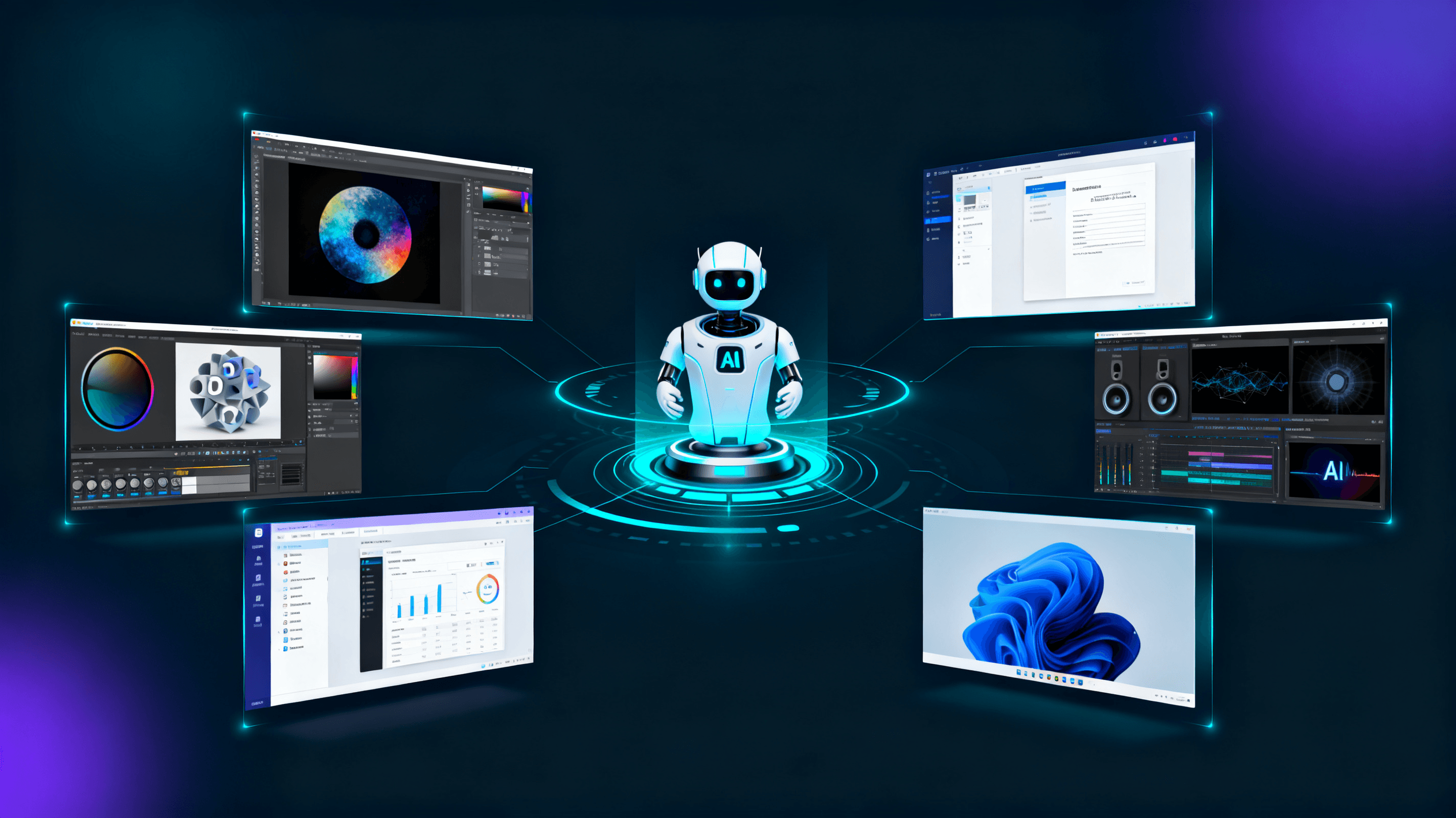
It has already generated working CLI tools for software such as GIMP, Blender, LibreOffice, Audacity, Kdenlive, and ComfyUI. That means agents can potentially edit images, render 3D scenes, convert documents, process audio, edit videos, and control AI image workflows through structured commands.
This is important because it shows that “software becoming CLI-native” is not just a vision. It is becoming technically practical.
When professional tools like Blender and GIMP can be controlled by agents, enterprise software will likely follow.
Feishu, DingTalk, and WeCom: A New Platform Race
The timing was striking:
- DingTalk released a CLI tool around March 27
- Feishu open-sourced its CLI around March 28
- WeCom also moved toward command-line access around the same period
The strategic logic is clear: the platform that becomes easiest for agents to use may become the default workplace infrastructure for the AI era.
Feishu appears to be taking the most open approach, with multi-layer command design, broad API coverage, structured output, dry-run options, AI agent skills, and MCP support.
DingTalk is building around its broader Alibaba ecosystem, with a more controlled enterprise-first approach and a dedicated MCP marketplace.
WeCom is moving more cautiously, but the fact that it is moving at all shows that the trend is becoming difficult to ignore.
Why CLI Instead of Just API?
APIs already exist, so why does CLI matter?
Because AI agents need interfaces that are discoverable, text-native, composable, and lightweight.
First, CLIs are self-discoverable. An agent can run --help and understand what the tool can do.
Second, CLIs are text-native. Large language models are fundamentally strong at processing text. GUI control often requires screenshots, pixel interpretation, and coordinate-based actions, which are slower and less reliable.
Third, CLIs are composable. Commands can be chained into workflows in ways that fixed API endpoints do not always anticipate.
Fourth, CLIs are lightweight. They run on demand, without maintaining heavy persistent sessions. For agents controlling many tools, that efficiency matters.
A Global Infrastructure Signal
This is not only happening in China.
Anthropic’s Claude Code is itself an example of a CLI-native AI product. Google has released tools for agent access to Google Workspace. Stripe is enabling agents to handle payments, subscriptions, and billing workflows. Shopify is opening commerce APIs for agent operations. MCP is becoming a common protocol for connecting models to tools.
When leading software companies around the world release agent interfaces, CLIs, and tool protocols in the same period, it is not a minor developer trend. It is an infrastructure signal.
From SaaS to Result-as-a-Service
Consider a simple operating workflow.
In the past, a human operator opened a collaboration platform, created documents, updated tables, sent messages, and scheduled meetings through a GUI.
Now, an AI agent can fetch data, generate reports, update tables, send summaries, and coordinate calendars through commands.
In the future, 80 percent of repetitive software operations inside a company may be completed by agents. Humans will define goals, review outputs, and handle exceptions.
This pushes software from SaaS, software as a service, toward RaaS, result as a service. Customers may no longer pay primarily for access to software. They may pay for outcomes generated through software.
Three Structural Changes Entrepreneurs Need to See
1. AI agents are becoming software users
Agents will not choose software because the UI looks beautiful. They will choose tools with clear APIs, reliable CLIs, structured output, and machine-readable errors.
Your next major user may not be a procurement manager. It may be an AI agent deployed inside a company.
2. Software competition will include agent-friendliness
Product competition used to focus on UI, UX, features, and brand. In the agent era, a new dimension appears: how easy is your software for agents to understand and operate?
Agent adaptation may become as fundamental as mobile adaptation once was.
3. Pricing models will evolve
When agents become major users, seat-based pricing becomes harder to interpret. One agent can run 24/7 and complete far more actions than a human.
New pricing models will emerge around API calls, processing volume, task credits, and outcomes. Value measurement will shift from “how many people use it” to “how much output it creates.”
Four Mindset Upgrades for Business Leaders
First, redefine the user. Your product, service, or content may be consumed not only by humans, but also by agents acting on behalf of humans.
Second, redefine the interface. APIs, CLIs, data formats, and documentation are also interfaces. Human interface design and agent interface design follow different rules.
Third, rethink the moat. If agents can switch tools quickly, beautiful UI may matter less. Proprietary data, reliability, ecosystem integration, and default position in agent workflows will matter more.
Fourth, redesign organizational capability. Companies will need fewer people who simply operate software and more people who can direct agents, design workflows, and evaluate outputs.
Final Thoughts
Every major computing platform redefines what “good software” means. In the PC era, software needed to be feature-rich. In the internet era, it needed to be online. In the mobile era, it needed to be touch-friendly. In the AI agent era, it needs to be machine-operable.
Software CLI-ification is not a niche technical trend. It is part of the infrastructure buildout for the AI agent economy.
Entrepreneurs do not need to convert every product into a CLI tomorrow. But they do need to understand that one of their largest future user groups may not be human.
The companies that prepare for this will gain a structural advantage in the next decade.
About MindsLeap
MindsLeap is an enterprise AI transformation and AI-native startup acceleration platform. Through the MindsLeap Founders AI Club, AI training and strategic advisory, FDE implementation, startup acceleration, and global growth services, MindsLeap helps traditional enterprises embed AI into real business workflows and helps AI-native ventures connect with industry use cases and global markets. MindsLeap is a global partner of Founders Space.
This article was translated and adapted from the Chinese original with AI assistance.