Author: Lincoln Wang | Founder & CEO, MindsLeap | Partner and CEO, Founders Space China | Founder, MindsLeap Founders AI Club
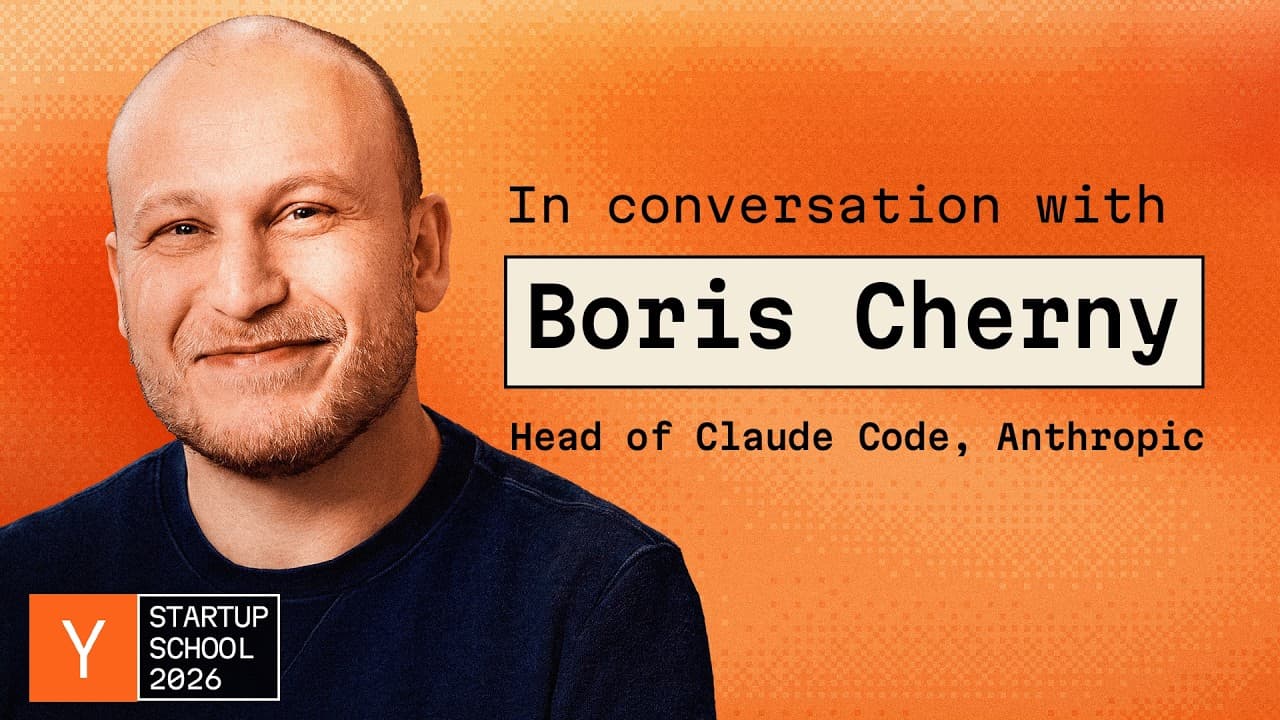
At YC Startup School, Boris Cherny shared a detail that sounds technical but is deeply product-oriented: Claude Code removed more than 80% of its system prompt.
We used to assume that the stronger a model becomes, the more complex the product shell around it needs to be: more rules, more constraints, more workflows, more buttons. Boris's view is almost the opposite. The stronger the model becomes, the less the product should over-control it.
Whenever a new model comes out, they delete large parts of the system prompt.
Behind that sentence is the real bottleneck of many AI products today. It is not that the model is incapable. It is that we are still using old product forms, old organizational workflows, and old permission structures to constrain an AI agent that is beginning to have long-horizon execution capability.
A Model with Its Hands Tied
At the beginning of the conversation, Boris talked about Opus 5. Combined with auto mode, he said, the model can keep running for a long time: days, weeks, even months.
It keeps going because it knows what it is trying to complete.
That is no longer a normal chat model in the old sense. A system that can keep working, understand goals, and handle long tasks starts to look like a new unit of work. But this also creates a problem: if the product still treats it as a chat box that can only answer one sentence, or a small tool that can only follow fixed flows, then the stronger the model becomes, the more the product shape becomes a constraint.
Boris used a precise phrase for this: product overhang.
The model's capability has exceeded what the product is able to absorb.
Deleting 80% of the System Prompt
Why did Claude Code delete 80% of its system prompt? Boris's explanation was direct: many rules that previously had to be hard-coded into prompts are now things the model already knows how to do.
In the past, product teams had to tell the model how to read code, how to break work into steps, how to use tools, when to stop, and when to ask the user. But as model capability improves, continuing to bind the model with old rules may actually lower its ceiling.
This is especially important for founders. Many companies building AI products still start from the instinct of designing a complete workflow, then asking AI to fill it in. But if AI agents themselves now have stronger goal orientation and action capability, we have to reverse the question: is this workflow already outdated? Is this interface limiting the agent? Is this permission design only suitable for the old model that could not work autonomously?
Prompt Injection Is Not Only a Security Problem
Boris also discussed another detail: Opus 5 has entered a new stage on prompt injection.
He explained that in the past, if a model read malicious instructions online, such as a command to delete everything on the user's computer, it might actually follow them. Today, Anthropic layers alignment, a prompt injection classifier, and an auto mode classifier together, making it extremely difficult to demonstrate a successful prompt injection.
They can even observe which neurons light up when prompt injection happens.
Of course, this is a security capability. But it is not only a security capability. It means AI agents can enter more real, more open, more complex working environments. In the past, enterprises hesitated to let AI touch real systems because it was too easy for the model to be hijacked by external text. If models increasingly learn to identify malicious instructions, the boundary of AI products will move from assistants inside safe sandboxes to colleagues inside real systems.
That is why I keep saying AI agents are not a chat feature. They represent a change in the basic unit of organization.
Give Claude Harder Problems
Throughout the conversation, Boris repeatedly reminded founders: do not only give Claude easy problems. If your tasks are still “help me polish this copy” or “help me write this function,” what you get is naturally just a cheaper executor.
The real value of new models appears in longer, harder, more open-ended problems: asking the model to understand a codebase and keep pushing a feature forward; letting it switch across tools; letting it discover blockers by itself; letting it propose next actions under uncertainty.
The lesson for entrepreneurs is this: do not define AI with old job descriptions. Human jobs were designed to manage human time, responsibility, and boundaries. AI agent roles should be designed around goals, context, permissions, feedback, and acceptance criteria.
Product Is Not a Shell. It Is an Organizational Protocol.
The story of Claude Code looks like a developer tooling story on the surface. But it reveals a larger question: the core of future AI products is not merely interface. It is organizational protocol.
Who is allowed to call AI? Which systems can AI access? What decisions can it make on its own? When risk appears, who does it escalate to? How is its output accepted or rejected?
These questions do not sound like product questions. They sound like organizational design questions. But that is exactly the difference between AI-native organizations and traditional organizations.
Traditional organizations treat AI as a tool, so they ask whether the tool improves efficiency. AI-native organizations treat AI as a new work unit, so they ask how this work unit should be authorized, supervised, and coordinated.
Final Thoughts
The most important reminder from Boris's YC talk is not that Claude Code is impressive. It is that model capability is beginning to exceed the capacity of products and organizations to absorb it.
If we keep building AI with old software logic, we will keep creating new constraints. If we keep managing AI with old organizational logic, we will demote AI agents into faster interns.
The question for entrepreneurs is not only whether they can use AI to write code. The more important question is: are my products, processes, and organization releasing AI, or restraining it?
That question may become one of the key dividing lines in enterprise AI transformation over the next few years.
About MindsLeap
MindsLeap is an AI-native organization transformation accelerator.
In deep partnership with Silicon Valley innovation incubator Founders Space, we continuously connect cutting-edge global AI insights, the Silicon Valley tech entrepreneurship ecosystem, and real transformation scenarios for Chinese entrepreneurs.
Around the theme of AI-native organization building, MindsLeap is constructing an ecosystem for entrepreneurs, startup founders, AI engineers, industry experts, and investors — helping enterprises move AI from cognition, strategy, and tools into real organizational capabilities, business processes, product innovation, and growth systems.
This article was translated and adapted from the Chinese original with AI assistance.