Author: Lincoln Wang | Founder & CEO, MindsLeap | Partner and CEO, Founders Space China | Founder, MindsLeap Founders AI Club
A Yellow Legal Pad From 1980
In this LangChain talk, Bridgewater's Brendan McManus did not begin with a model or a framework.
He began with a piece of paper.
It was Bridgewater's bond system from 1980, written on a yellow legal pad. According to Brendan, for nearly fifty years the company has been doing something both simple and difficult: writing its understanding of markets and economies into explicit rules.
He quoted Ray Dalio's early instruction:
"Every time you want to make a trade, write down exactly the rules that make you think that trade should work."
On the surface, this is an investing method. In the AI era, it is also a lesson in how organizations prepare for agents.
While many companies are still asking whether they can connect a model to their workflow, Bridgewater is starting from a very different place. It is not scrambling to feed knowledge into an agent. It has already spent decades turning research methods, data systems, internal tools, terminology, and judgment patterns into context that an agent can use.
Brendan put it directly:
"We don't have to go back and rewrite everything for agents. It's already there."
That may be the most important signal in the talk.
AI does not make an organization intelligent from nothing. It amplifies what the organization has already written down, structured, and made reusable.
PAT Is Not a Chatbot
Bridgewater's tool is called PAT, the Pocket Analyst Tool. You can think of it as an internal AI analyst.
Brendan set a clear boundary at the beginning:
"PAT is not about how we trade."
That matters. When people hear Bridgewater, AI, and investing in the same sentence, they often jump to automated trading, market prediction, or some mysterious financial black box. But the point of this demo was not trading decisions. It was the research process.
PAT addresses a concrete bottleneck: investors have many questions worth exploring, but expert research time is limited. Its goal is to compress hours of expert research into minutes.
In the demo, the team asked PAT to analyze market reactions after recent Middle East conflict and compare them with historical oil supply shocks. That sounds like a normal research question, but inside a real institution it becomes complex quickly.
The agent needs to find the right time-series data, understand which historical events are comparable, generate charts, check whether the numbers make sense, and leave behind an execution trail so both humans and backend agents can diagnose what happened.
This is not "ask a model a question."
It is putting an AI agent into a real organizational research workflow.
The Real Moat Is Context
PAT works not because Bridgewater connected a better model, but because Bridgewater has context that is hard for others to copy.
Brendan explained that PAT must read structured data, such as decades of equity prices and macro time series. It must also read unstructured material, such as external research and internal memos. It has to use the proprietary tools human analysts already use, including visualization, diagnostic, and metric evaluation tools.
Most importantly, PAT knows how Bridgewater analysts are expected to work.
"It knows exactly how our analysts should do research because we have been writing these things down for fifty years."
That line should be a warning for Chinese entrepreneurs.
Many companies start AI-agent work by looking for models, tools, and vendors. But the ceiling of an agent is often determined not by model parameters, but by whether the company has clearly documented its own business method.
Has a sales team written down how it judges customer quality?
Has a manufacturing company written down how abnormal orders should be investigated?
Has a consulting team written down its method for interviews, diagnosis, delivery, and review?
If these things live only in the heads of a few senior employees, the agent becomes a smart outsider who does not understand the company. It may answer generic questions, but it will struggle to take on real work.
Bridgewater's case reminds us that the first asset of an AI-native organization is not the prompt. It is organizational knowledge that machines can read, humans can review, and teams can keep improving.
"The Plan Itself Is Analysis"
My favorite sentence from the demo came from Michael Ran:
"The plan itself is analysis."
This may sound like an engineering detail, but it is actually a deep work-method insight.
Before PAT writes code, pulls data, or draws charts, it asks clarifying questions and turns a vague request into a high-quality research plan. Michael noted that humans often underestimate the value of planning. PAT's back-and-forth questions can help the person clarify the real question.
This is the opposite of how many companies use AI today.
People treat AI as an instant-answer machine. They want to throw in a question and get a conclusion immediately. But in complex business work, the most valuable part is often not the answer. It is decomposing the problem correctly.
PAT's planning phase defines what tables need to be produced, what structure each table should have, and how those tables relate to one another. This planning takes time, but Bridgewater accepts the cost because execution can then happen in parallel.
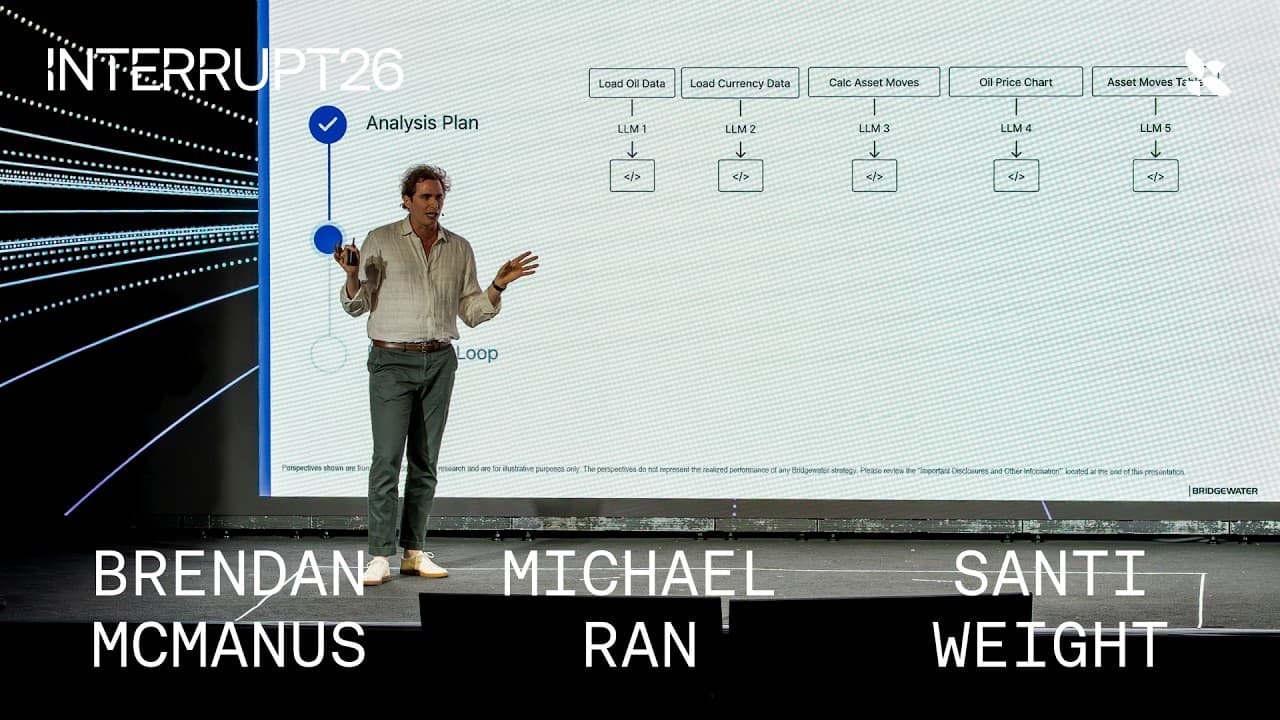
With a detailed plan, the agent can hand different data-table generation tasks to multiple subagents. Santi Weight later explained that in their architecture, a twenty-task plan can take nearly the same time as a three-task plan.
The lesson is clear: an AI agent is not a single smart brain. It is an execution system that can plan, parallelize, verify, and reuse work.
Future enterprise process redesign may not mean handing one role to one AI. It may mean decomposing a complex workflow into many work units that can be planned, verified, and parallelized.
From 50% to 90%: The Improvement Was Not Magic
One concrete detail inside PAT is time-series search.
Bridgewater has tens of millions of internal time series. When a user asks a research question, PAT needs to find the right data. Early simple search was only about 50% accurate. Later, the team embedded how human researchers check data: frequency, currency, prior knowledge, and the meaning of the series. Accuracy rose to roughly 90%.
This detail is valuable.
It shows that agent improvement does not come from saying "make the model smarter." It comes from making expert tacit actions explicit.
A great analyst does not just match keywords. They judge whether data uses the same definition, the same time frequency, and whether it truly relates to the question. Bridgewater put these judgments into the search agent, and the system improved.
This is exactly where enterprise AI deployment is often misunderstood.
We keep looking for a more general model, but much of real business value comes from specific detail: which fields matter in an approval, which signals trigger escalation in customer service, which seasonal factors should be excluded when diagnosing store performance.
If agents are going to get stronger, these details must be written into the system.
A System That Can Be Taught
PAT is not a product that was built once and left alone.
Brendan said:
"PAT is not a prototype anymore."
It has been deployed internally at Bridgewater for several months, with hundreds of investors using it every day. The number is interesting, but the learning loop behind it is more important.
As investors use PAT for real research, backend agents continuously scan interactions, identify where PAT made mistakes, generate human-audited benchmarks, and then improve the context and harness. In other words, the system does not only serve one user. It improves through real use and benefits everyone.
The demo also showed a button called Teach. When a user sees something that needs correction, they can click Teach. A backend agent then analyzes whether there was a behavior error, a context gap, or an opportunity to guide the user earlier. It generates an expected-failure benchmark, iterates on a fix, and can even generate a PR.
This goes beyond "humans rating AI."
It turns human feedback into system improvement work.
That is the key to bringing enterprise agents into production: not just having a model answer questions, but having a mechanism that captures errors, reviews them, converts them into new context, new tests, and new processes.
Without this loop, more agents simply mean more uncontrolled conversation windows.
With this loop, agents can become part of organizational capability.
Treat the Agent Like a Compiler
In the second half of the talk, Santi Weight offered a powerful analogy.
With a background in compiler theory and programming-language design, he said the team increasingly sees agentic coding like building a compiler.
"A compiler compiles user code into JavaScript. A coding agent compiles a user prompt or plan into Python."
That analogy is precise.
If you treat AI-generated code as "letting the model improvise," the system will be unstable. If you treat it as a compiler problem, you naturally care about determinism, correctness, reliability, static analysis, dependency relationships, and verification.
Bridgewater's architecture asks the chat agent to form an analysis plan first, then call a coding agent. The coding agent does not freely write a block of code. It generates code according to tasks in the plan, and a verification agent checks whether the code satisfies the task. If not, it continues to revise.
They also use static analysis and caching annotations so repeated runs can become almost instant.
This is why the talk is not only a financial-industry case. It describes a more general enterprise agent architecture: turn natural-language needs into structured plans, turn plans into executable code, pass results through verification, and convert errors into continuous improvement.
That pattern will show up in many industries.
Consulting, manufacturing, healthcare, legal services, education, finance, and cross-border commerce will all face the same question: how do we turn expert processes into executable, auditable, improvable AI work systems?
Final Thought: Do Not Just Buy Models. Capture Method.
This article is not investment advice and does not discuss any specific trading judgment. The value of Bridgewater's case is not that it tells us where markets are going. It shows how a mature organization can connect AI agents to its knowledge system.
For Chinese entrepreneurs, the lesson has three layers.
First, companies need to rethink knowledge management. In the past, knowledge management often meant archiving documents that later went to sleep. In the AI era, knowledge must become working context that agents can read, call, and verify.
Second, companies need to rethink processes. A process should not exist only to make people fill out forms. It should make complex work decomposable, parallelizable, checkable, and reusable. Only a clearly decomposed process can be handed to agents.
Third, companies need to rethink feedback. Every correction an employee gives to AI should not remain just a chat record. It should become material that improves the system.
Bridgewater used fifty years of yellow-pad rules to grow today's PAT.
What we should learn is not the yellow pad, nor finance itself, but the organizational habit behind it: write down experience, structure methods, and turn mistakes into improvement.
AI will force many companies to realize for the first time that the scarce asset is not the model. It is the work methods that have been seriously captured.
Whoever writes them down first will have the soil where AI agents can truly work.
About MindsLeap
MindsLeap is an AI-native organization transformation acceleration platform.
Through deep collaboration with the Silicon Valley innovation incubator Founders Space, MindsLeap connects global AI frontier thinking, Silicon Valley's technology entrepreneurship ecosystem, and the real transformation scenarios of Chinese entrepreneurs.
Around the development of AI-native organizations, MindsLeap is building a transformation ecosystem for entrepreneurs, founders, AI engineers, industry experts, and investors, helping companies move AI from cognition, strategy, and tools into organizational capability, business workflows, product innovation, and growth systems.
This article was translated and adapted from the Chinese original with AI assistance.