
Author: Lincoln Wang | Founder and CEO of MindsLeap | Partner and CEO of Founders Space China | Founder of MindsLeap Founders AI Club
The cover is an AI-generated conceptual illustration, not a documentary photograph.
Twenty-four years old, just starting a career, and already managing a team. Except that the team has no other people in it. It consists entirely of AI.
This is the experience Hemanth Asirvatham and Elliott Mokski describe in The Future of the Firm. Their article, published on OpenAI's website, is not simply about how much work AI can do for us. It asks a question that deserves entrepreneurs' attention: where will AI sit in a company's organization chart? The authors explicitly state that these are their personal views, not OpenAI's official position.
They outline three scenarios: AI beneath people, beside people, or between people. These are not validated organizational templates. They are three perspectives on possible human-AI collaboration. I will follow those perspectives and then explain how I understand their implications.
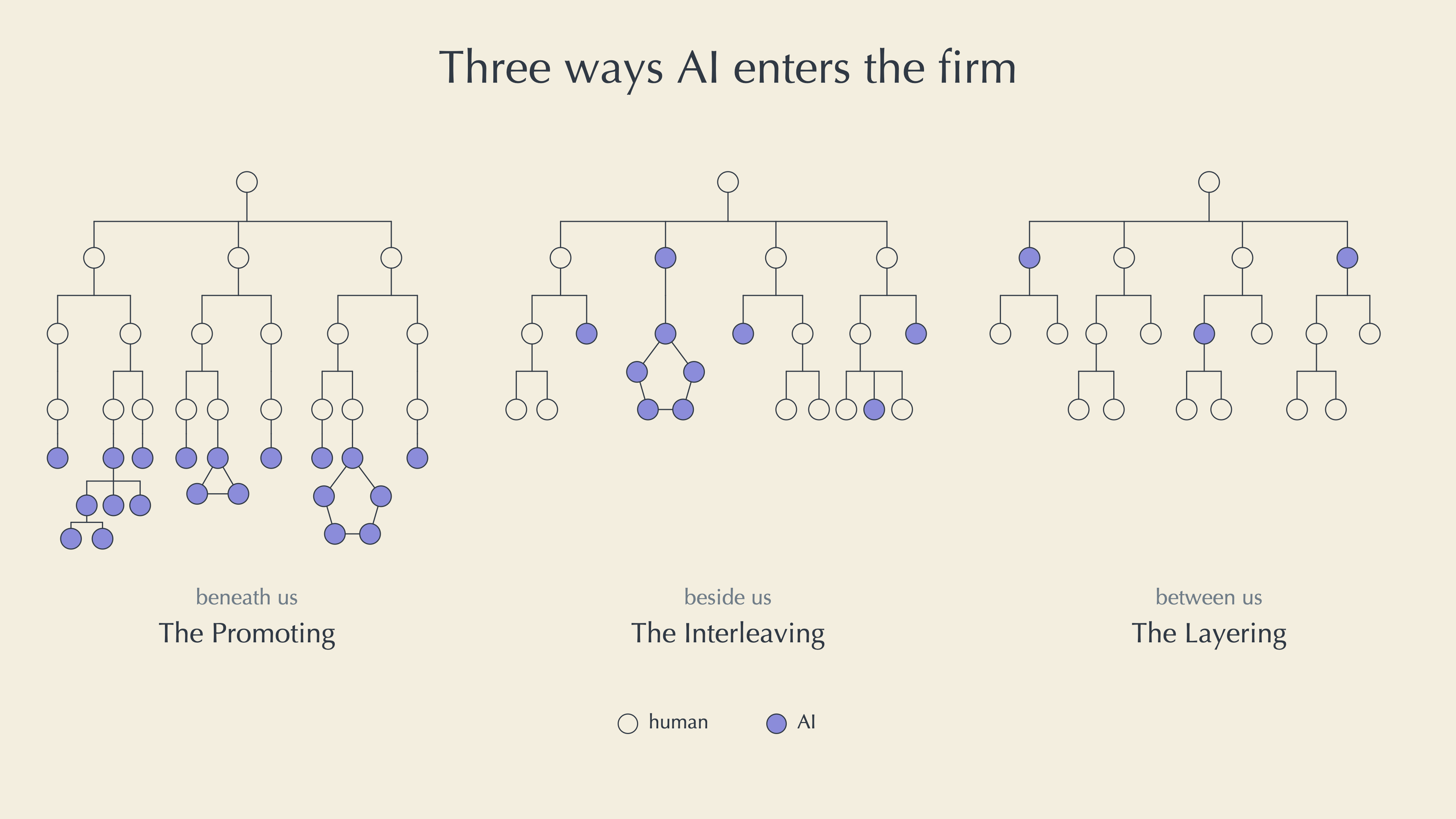
Image credit: OpenAI, The Future of the Firm. From left: promoting, interleaving and layering. Open circles represent humans; purple circles represent AI.
You Have Not Been Promoted, but You Have Direct Reports
The first scenario is called promoting. Human reporting lines stay the same, but AI labor appears beneath each employee. The authors' point is straightforward: everyone becomes a manager.

Image credit: OpenAI, The Future of the Firm. The illustration explores an individual leading an AI team.
What makes this interesting is that an employee's rank may stay unchanged while the nature of the work shifts. We have traditionally assessed a professional by what that person can do personally. If people can organize AI agents to accomplish more, we also need to ask what results they can bring into the organization.
Following this scenario, an employee who understands customers well might not need a human team before testing an idea. They could organize research, analysis and proposal development, then use the results to seek resources. Some execution capacity that once came with a position might arrive before the position itself.
But this is not a free promotion. Being able to call AI does not confer judgment, and delegating a task does not mean knowing which results to accept. My interpretation is that professional expertise becomes more important, while its expression expands from doing the work to defining problems, organizing execution and judging outcomes.
The company faces a new question, too: how much room should a newcomer have to experiment when they can mobilize far more output than before? Without matching authority, execution capacity may sit idle. Without matching responsibility, mistakes may be amplified.
The Boss Connects to an AI Team
The second scenario is interleaving. AI is not just a personal assistant. It can join a team and receive work directly from an existing manager. Its position is alongside people.
The article imagines Sheila, a furniture-company vice president, asking an AI marketing team to promote a sofa. She receives a proposal and a question about whether the photographs need to be retaken. This is a hypothetical future scenario, not a report about a company already operating that way.

Image credit: OpenAI, The Future of the Firm. The illustration explores human and AI teams working alongside one another.
This shifts our attention from employees using tools to managers gaining capabilities. The two may look similar, but the logic of purchasing and using them could differ.
If the company buys a tool, someone must learn it and work out how to fit it into a process. If it connects to a team capable of delivering a defined outcome, the manager's first questions may instead be: what goal does it understand, how much responsibility can it take, and when should it ask me for help?
That is a demanding capability threshold. Generating advertising copy is not the same as running marketing. Completing a few tasks is not the same as taking responsibility for an entire function. A product interface that looks like a group of colleagues does not prove that it has team-level capabilities.
What I find promising is the possibility that companies could acquire expertise differently. A business might not have to establish a complete department in every field before exploring a new direction. But acquiring execution capacity does not automatically resolve who chooses that direction, accepts the trade-offs or bears the business risk.
AI Begins Connecting the Boss and the Employees
The third scenario is layering. People remain above and below, while AI takes on coordination in the middle. Its position is between people.

Image credit: OpenAI, The Future of the Firm. The illustration explores AI connecting different organizational layers.
The most important question is not whether a robot can acquire the title of manager. It is whether management work can be separated into different parts. Some of it concerns understanding information, detecting deviations and coordinating action. Other parts involve trust, interests, values and ultimate responsibility. They do not necessarily have to be performed by the same actor.
Following this line of thought, future managers might spend less time collecting updates through successive layers and more time on decisions that genuinely require human judgment. But that takes more than an AI that has read enough files. It must also recognize when information is outdated, context is missing or it should not reach a conclusion.
We need to be particularly careful about one distinction: understanding an organization is not the same as monitoring it. A system that can describe what employees did does not necessarily understand why they did it. Turning analysis directly into evaluation, or advice directly into orders, can transform an assistive capability into untested authority.
In my view, the biggest uncertainty in this scenario concerns governance as much as technology. Will AI help different levels understand each other, or simply make it easier for those above to intervene in those below? The same capabilities could serve very different organizations.
What Changes Is the Relationship Between Capability and Position
Taken together, these scenarios suggest a common change: the capability a person can mobilize may depend less and less on how many people report to them.
That does not mean positions disappear. A position also represents budget, authority, responsibility and commitments to other people. But if execution capacity can be acquired through AI, the historically close connection between position and capability may loosen.
This is what I think entrepreneurs should consider seriously. The important people in future companies may not always be those managing the most staff or controlling the most information. They may be those who ask better questions, organize different capabilities and deliver results. Reflecting that contribution in compensation and promotion takes new institutional arrangements, not merely an AI prefix attached to an old job.
I do not believe all companies will converge on one structure. A business requiring physical operations has different opportunities for delegation than one mainly delivering digital outputs. Highly standardized processes and relationships built on long-term trust will not have identical organizational answers, either.
More likely, several human-AI relationships will coexist inside one company. Some people will lead AI, some will work alongside it, and some will use it to understand an entire team. What changes is the combination of collaboration, not simply the employee roster.
The Next Company Must First Decide What People Are Responsible For
It is easy to reduce this discussion to a simple conclusion: if AI can do more, companies should employ fewer people. But a company is not merely a payroll waiting to be compressed. It also creates demand, builds trust, coordinates resources and fulfills commitments.
I am more interested in whether a company has worthwhile goals for its growing execution capacity. More proposals do not necessarily produce better choices, and faster action does not guarantee the right direction. Someone still has to decide which things are worth doing, which costs are unacceptable, and how to face customers and employees when something goes wrong.
This is one starting point for how I understand an AI-native organization. We should not erase people from the chart and fill the spaces with AI. We should discuss which capabilities AI can take on, which decisions require people, and how both can share responsibility for results.
The firm of the future may have more than one structure. Wherever AI sits, entrepreneurs will need to answer the same question again: with these new capabilities, what kind of company do we want to become?
Reference: Hemanth Asirvatham and Elliott Mokski, The Future of the Firm. This article offers independent commentary on their three organizational scenarios; it does not present future scenarios as established implementations.
About MindsLeap
MindsLeap is an enterprise AI transformation and AI-native startup acceleration platform. Through the MindsLeap Founders AI Club, AI training and strategic advisory, FDE implementation, startup acceleration, and global growth services, MindsLeap helps traditional enterprises embed AI into real business workflows and helps AI-native ventures connect with industry use cases and global markets. MindsLeap is a global partner of Founders Space.
Explore where enterprise AI transformation begins and the MindsLeap Founders AI Club.