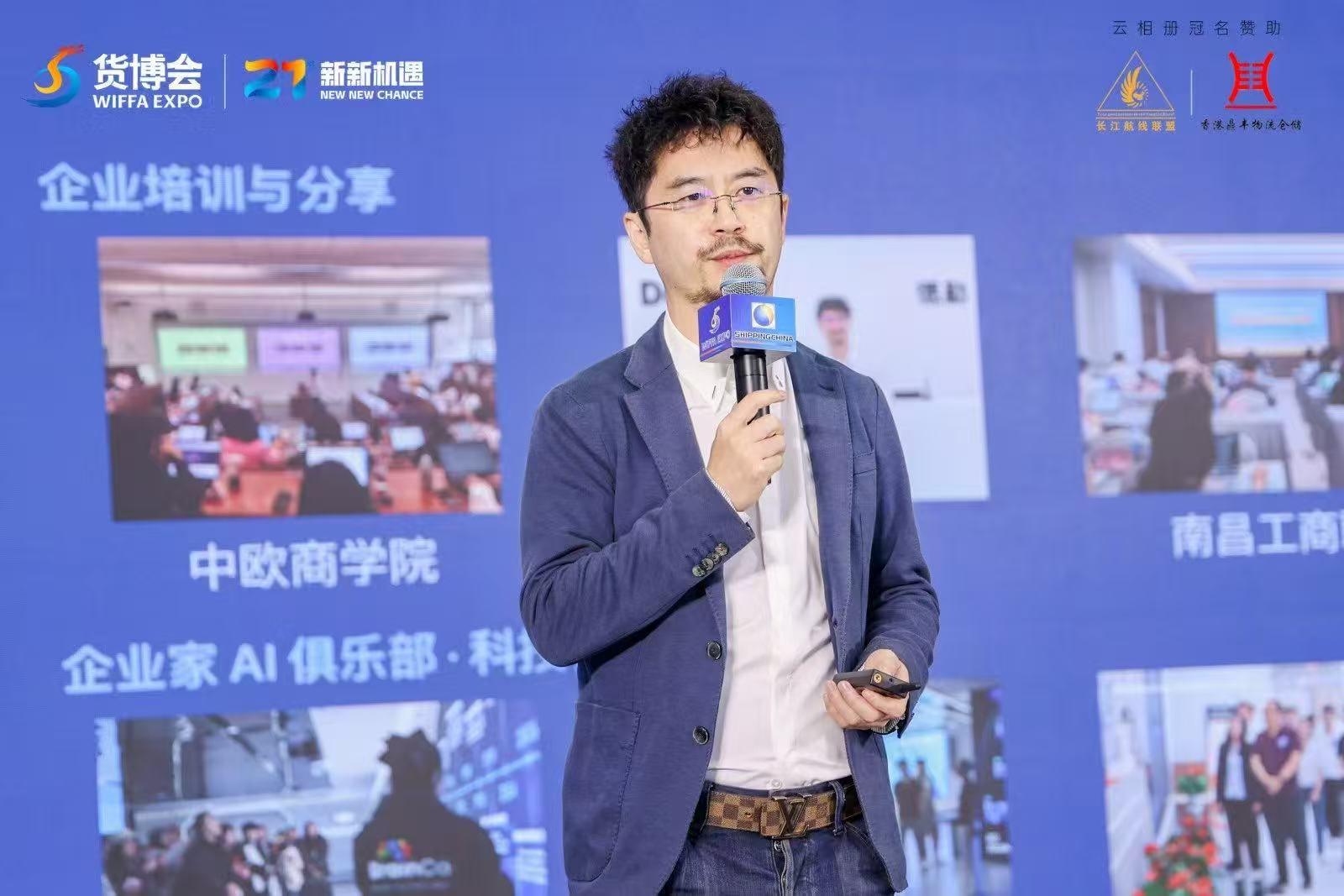
Lincoln Wang, Founder and CEO of MindsLeap and Partner at Founders Space, recently attended the 21st World International Freight Forwarding Alliance Expo in Ningbo. His presentation explored AI-native enterprise transformation and digital employees, using freight forwarding and logistics scenarios to discuss how AI can move beyond individual tools and become a sustainable organizational capability.
The event took place on November 3–7, 2026, with the core exhibition running November 4–6 at the Ningbo International Conference and Exhibition Center. Exhibitions, business matchmaking, and thematic forums brought together businesses across the freight industry chain. Official expo information
Rather than beginning with model rankings or a list of tools, Lincoln brought the discussion back to everyday work: as a shipment moves from an initial request to delivery, which repetitive tasks can AI handle? Which judgments remain a human responsibility? And how can one improvement become a capability the whole team can reuse?
Start the First Digital Employee with a Clearly Defined Task
Lincoln proposed a practical starting point for AI transformation: identify a task that is both worth doing and feasible to implement.
Organizing emails, extracting shipping-document information, entering records, checking discrepancies, and following up on action items are tangible entry points. But repetition alone does not make a task ready for automation.
The presentation suggested assessing initial pilots from two perspectives. Feasibility means clear inputs, explainable business rules, and outputs that can be evaluated. Business value means understanding task frequency, the staff time involved, and whether repetitive work is prone to errors.
A digital employee's value is not simply saving a few clicks. It is freeing people to spend more time on judgment, decisions, customer communication, and delivery accountability.
From People Using AI to AI Advancing Collaboration
Lincoln introduced three ways AI can work within an organization:
- People use AI: people assign tasks and review the results, while AI assists with reading, organizing, and checking information.
- AI advances workflows: systems detect changes, connect tasks, and direct decisions to the appropriate person.
- People manage systems: people establish rules and authorization boundaries, while Agents perform standard tasks and escalate exceptions.
These are not mandatory steps that every business must complete in sequence. They can coexist according to business risk and system maturity.
Detecting missing information, identifying status changes, and reminding responsible colleagues can gradually become system-supported activities. Customer commitments, fee confirmations, and important trade-offs still require clear decision makers and accountable owners. Automating a workflow does not remove responsibility.
Give the Business a Shared Basis Before Asking AI to Understand It
General knowledge does not tell AI which quote is currently valid, what special requirements a customer has, or why a particular commitment was made.
Lincoln explained that businesses need to connect facts, decision rules, and actions: which materials are current, who can confirm them, under what conditions they apply, and who resolves conflicting information.
Organizational experience should not remain solely in individual employees' heads. Customer preferences, past exceptions, and special agreements need sources, confirming owners, scopes of application, and expiry conditions before they can become shared reference points for people and AI.
On this foundation, Memory preserves valid facts and decision context, Skills codify methods, and Workflows define collaboration and execution. The result is not merely a growing collection of documents, but business capability that can be maintained, used, and tested.
Test Not Only What It Can Do, but When It Should Stop
A successful demonstration is not enough to establish whether a digital employee is ready for real business work.
The presentation used freight-forwarding exceptions to illustrate acceptance criteria. When documents conflict, does the system flag discrepancies for human confirmation? When a quote has expired, does it pause the order? When a request times out without confirmation, does it check the status before trying again to avoid duplicate submissions?
Questions grounded in business operations can become a company's Private Evals: internal acceptance and regression tests.
Lincoln emphasized that quality, exception response, duplicate-action risk, and actual fulfillment should be evaluated alongside speed. Digital employees need to know not only how to advance work, but when to stop, seek confirmation, or return control to a person.
Build a New Organizational Capability One Shipment at a Time
The presentation also explored a possibility: customers may eventually send Agents to query, compare, and use logistics services on their behalf.
This does not mean fully unattended transactions are already widespread. It is a reason for businesses to consider whether services can be described clearly, prices and status can be checked promptly, and interfaces have explicit authorization and execution boundaries.
Lincoln's immediate recommendation remained concrete. Rather than promising an entirely unmanned company, select one route, one type of cargo, and one customer group. Define the owner, information sources, acceptance criteria, and stopping conditions for one real workflow, then expand authorization after validation.
Start by making one shipment workflow work, and build toward a new organizational capability.
The session brought AI-native organization design into the practical context of freight and logistics. Its proposed starting point was not acquiring more tools, but aligning understanding, technology, and accountability so that digital employees can enter real workflows and local efficiency gains can become reliable collaboration and delivery capabilities.
MindsLeap will continue connecting frontier AI thinking with enterprise practice in China through training, advisory work, and practical exchanges, helping businesses explore transformation paths suited to their needs.