Author: Lincoln Wang | Founder & CEO, MindsLeap | Partner and CEO, Founders Space China | Founder, MindsLeap Founders AI Club
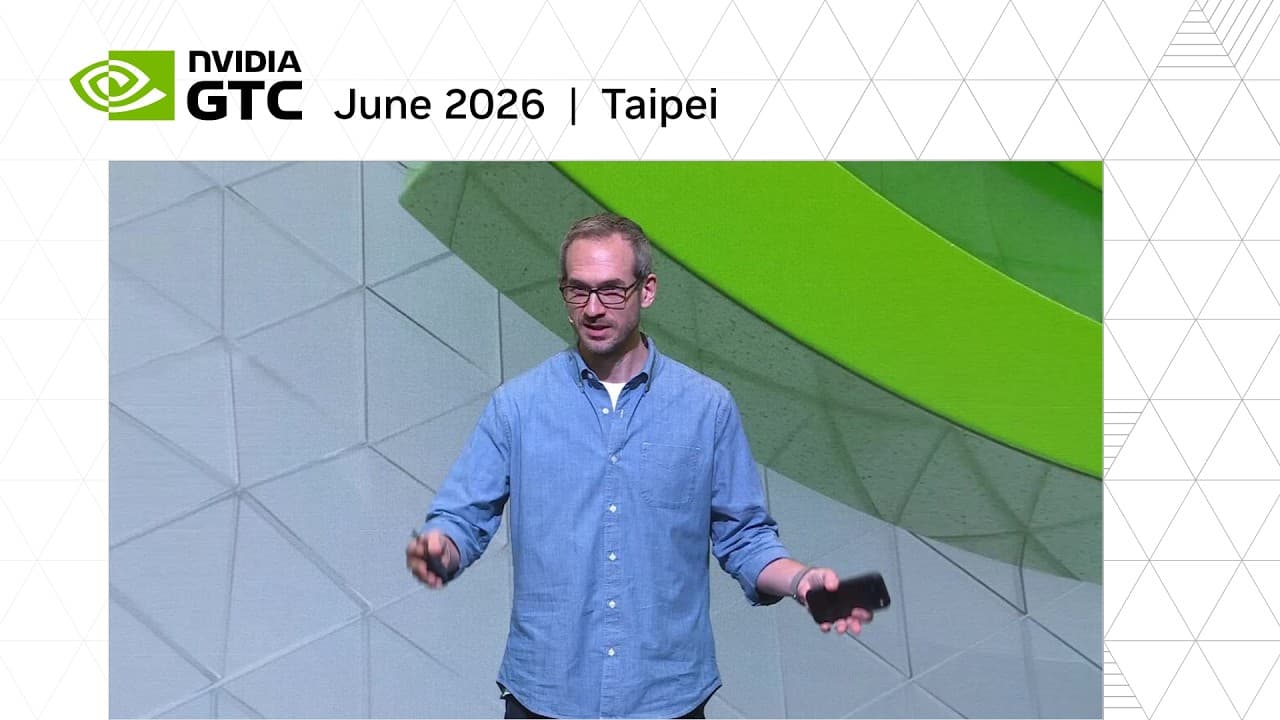
Jason Hardy opened his GTC Taipei session with a self-introduction. He said he is NVIDIA's vice president of storage technology, then added with a smile that he is the storage person inside a company that does not sell storage.
That opening sounded like a small joke, but it pointed to a real shift inside NVIDIA. NVIDIA is no longer only a GPU company. As AI moves from training to inference, from chat to AI agents, compute is only the first layer. What determines whether enterprise AI can actually land is whether data can be understood, orchestrated, protected, and delivered to the right agent at the right moment.
This talk may not have the same viral energy as a Jensen Huang keynote. But it addressed one of the most underestimated layers in enterprise AI implementation.
Data Describes a Company’s Character
Hardy used a very interesting definition of data. In his words, data describes the character of a company.
That is not how most technologists usually talk, but it is unusually precise. A company's ERP systems, databases, contracts, emails, documents, SharePoint folders, PDFs, videos, audio, customer service records, R&D materials, and supply chain data are not just information assets.
Together, they form the company's memory, habits, boundaries, and way of acting. If AI agents are going to work on behalf of a company, they cannot only understand general knowledge from the internet. They must understand who this particular company is.
Why Many AI Projects Stop at POC
Hardy also touched on a practical problem: many AI projects are abandoned, or never move beyond proof of concept. The reason is not always that the model is too weak. More often, enterprise data is not ready.
The quality of AI depends on the data it is fed, trained on, and allowed to use.
This sounds obvious. But when companies actually build AI systems, they discover that this obvious truth is expensive. Data is scattered across systems, permissions are inconsistent, formats are fragmented, security boundaries are unclear, real-time access is limited, and business semantics are missing. A demo may look impressive, but once it enters a real workflow, it starts to drift.
That is why I keep saying AI transformation is not about installing a few tools. It is about rebuilding the organizational foundation.
Three Kinds of Data, Three Kinds of Difficulty
Hardy divided enterprise data into three categories.
The first is structured data: ERP, SQL, and databases. It may not be the largest category by volume, but many business decisions depend on it.
The second is unstructured data: personal directories, documents, PDFs, videos, audio, and shared files. This is the largest part of many enterprise data environments, and often the hardest to process.
The third is the new data created in the AI era: models, vectors, embeddings, inference context, and the data generated while agents execute tasks.
Traditional enterprise IT systems were built mainly around the first two categories. Once AI agents enter the organization, the third category becomes increasingly important. Agents do not only read information. They plan, execute, call tools, produce intermediate results, leave decision traces, and turn those traces into context for the next action.
That means the enterprise data platform is no longer only a place to store things. It is becoming the workplace where AI agents operate.
“AI-Ready” Is Not Just Marketing Language
The core phrase in NVIDIA's talk was AI-ready data platform. If we translate that too casually, it becomes a slogan. In business terms, it has a very concrete meaning: data must be safely, continuously, and permission-consciously callable by AI; data services need to be integrated with accelerated computing, high-performance storage, and security mechanisms in one architecture.
In the past, enterprise data platforms were built around how humans query data, view dashboards, and make decisions. In the future, the central question will be how AI agents obtain business context inside enterprise systems and act reliably.
That is the difference. Humans can tolerate slowness, fragmentation, and manual patching. If AI agents are going to enter real operations, context, permission, latency, security, and auditability have to work at the same time.
From Compute Competition to Data Competition
When many entrepreneurs talk about AI, their first instinct is still models and compute. These are important, of course. But NVIDIA itself is reminding the market that the next layer of competition is data and infrastructure.
Without a usable data foundation, even the strongest model can remain trapped in demos. Without permission and security design, stronger agents create greater risk. Without real-time context, agents can produce answers that look correct but are detached from the actual operating environment.
So building an AI-native organization does not begin with buying an AI tool. It begins with re-understanding your own data. Where is your enterprise data? Who can access it? Are the semantics clear? Can it be called by AI agents? After it is called, can the trace be audited?
These questions are moving from the CIO's technology agenda to the CEO's operating agenda.
Final Thoughts
This NVIDIA talk did not feature a dramatic robot, a spectacular launch, or a line designed for social media. It matters precisely because it spoke about the plainest and hardest layer of AI implementation.
Enterprises do not lack data. The problem is that data has not yet become actionable context for AI agents.
When Hardy says data describes a company's character, he is reminding entrepreneurs of something essential: AI transformation is not first about helping models understand the world. It is first about helping models understand your company.
Whoever completes that work first will have a real chance to turn AI from a tool into an organizational capability.
About MindsLeap
MindsLeap is an AI-native organization transformation accelerator.
In deep partnership with Silicon Valley innovation incubator Founders Space, we continuously connect cutting-edge global AI insights, the Silicon Valley tech entrepreneurship ecosystem, and real transformation scenarios for Chinese entrepreneurs.
Around the theme of AI-native organization building, MindsLeap is constructing an ecosystem for entrepreneurs, startup founders, AI engineers, industry experts, and investors — helping enterprises move AI from cognition, strategy, and tools into real organizational capabilities, business processes, product innovation, and growth systems.
This article was translated and adapted from the Chinese original with AI assistance.