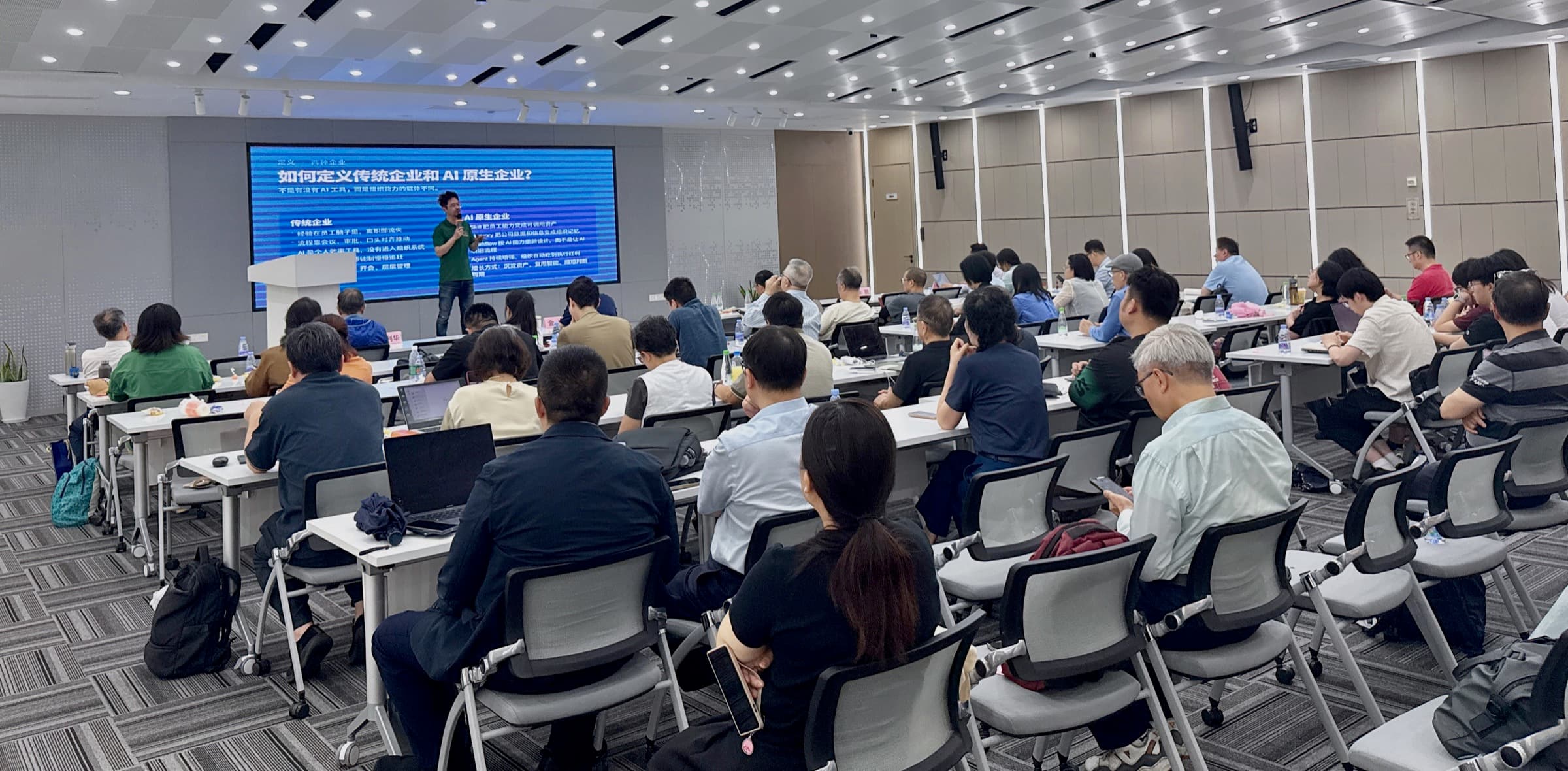
June 24, 2026 | Pudong, Shanghai
On June 24, 2026, MindsLeap joined the Pudong e-commerce association to share how an e-commerce business can develop into an AI-native organization. The session was designed for association members and industry managers. It focused on business operations and organizational design rather than simply adding more AI tools.
E-commerce combines frequent content production, advertising, merchandising, customer service, membership operations, and management reporting. These activities offer many practical AI entry points, but they can also create fragmented adoption: employees use separate tools and produce isolated outputs without building shared organizational capability.
An AI-Native Organization Is More Than a Team Using AI Tools
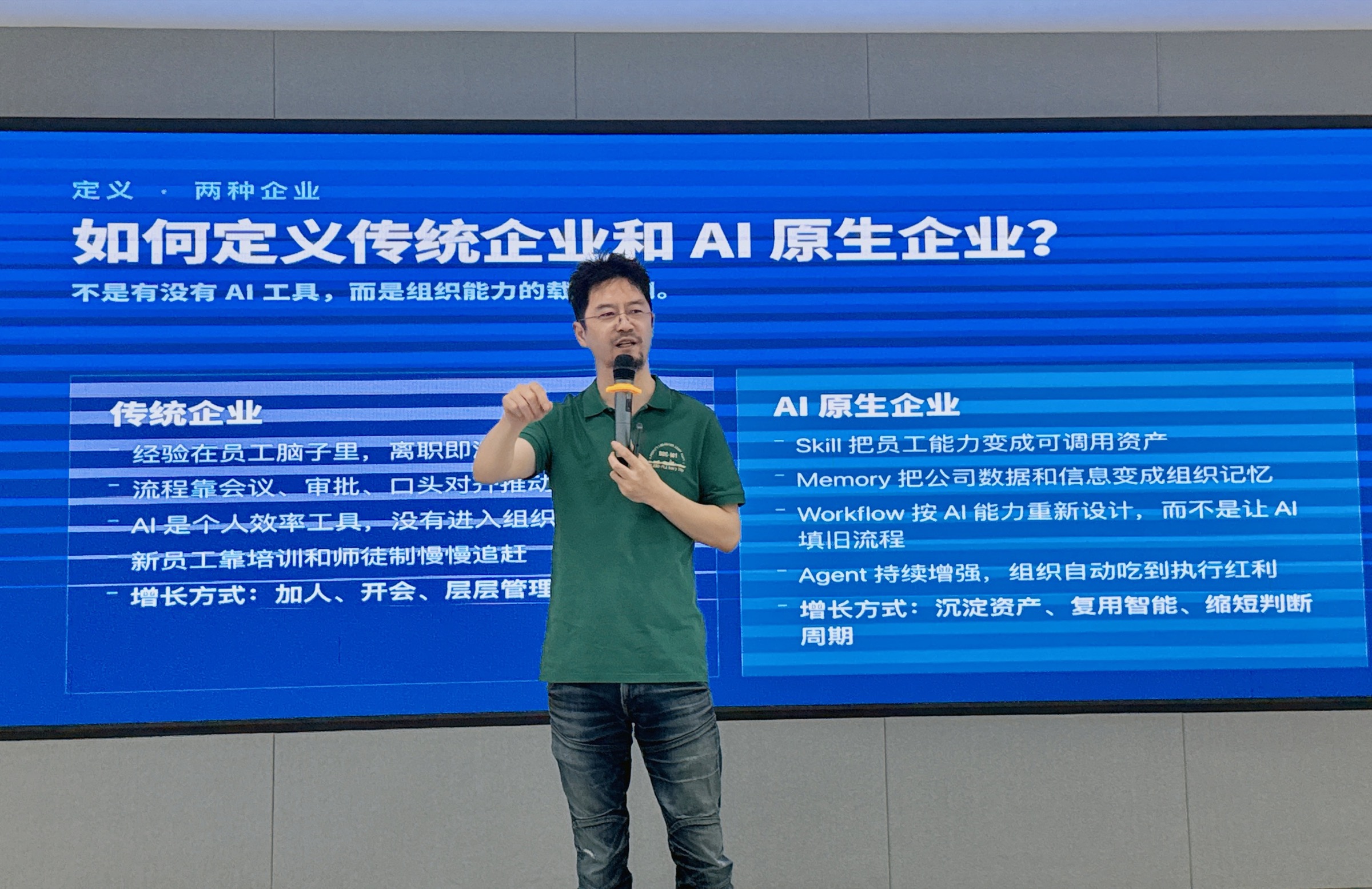
The session began by distinguishing a traditional enterprise from an AI-native organization. The difference is not just access to a model or software. It is whether capabilities, information, processes, and execution can be reused and improved by the organization.
In many traditional organizations, experience remains inside individual employees, processes depend on meetings and manual follow-up, and AI functions mainly as a personal productivity tool. An AI-native organization seeks to capture employee methods as Skill, convert company information into Memory, redesign each Workflow around AI capabilities, and use an Agent for repeatable execution and feedback.
This makes AI-native transformation a management responsibility. Leaders must decide which knowledge should be captured, which processes should be redesigned, where human judgment remains essential, and how Agent outputs will be reviewed.
Four Organizational Assets That Can Accumulate
MindsLeap used four connected concepts to describe the transformation path:
- Skill captures a repeatable method for solving a category of business problems
- Memory makes product, customer, content, campaign, and operating information retrievable over time
- Workflow organizes tasks, tools, data, and human checkpoints around a business objective
- Agent executes a defined category of work within clear responsibilities, permissions, and acceptance criteria
These are not four independent systems. Memory gives an Agent context, Skill describes how to work, Workflow connects the Agent with people and systems, and real feedback is used to revise both Skill and Memory.
Practical Entry Points for E-commerce
The discussion applied this method to familiar operating activities. A marketing team can begin with competitor and platform monitoring. A content team can connect product information with channel-specific copy. A customer-service team can organize frequent questions and response drafts. Managers can begin with weekly reporting, meeting actions, or cross-functional information flow.
The best starting point is not necessarily the most advanced-sounding use case. It should be frequent, have relatively stable inputs, produce reviewable outputs, and have a clearly accountable business owner. Completing one small end-to-end workflow generally gives the organization a stronger learning loop than launching many Agents at once.
Moving from Individual Use to Organizational Capability
An AI-native transformation can progress through three levels:
- Individual tasks: employees use AI for research, drafts, analysis, and other defined activities
- Team workflows: effective methods become shared templates, Skills, and review rules
- Organizational systems: data, permissions, and business systems connect multiple Agents within a governance framework
Business leaders need to participate throughout this process. They are best positioned to determine which tasks matter, what a valid result looks like, and which information or decisions must remain protected. Technical teams can help build the system, but operating standards cannot be fully outsourced.
A Practical Next Step for E-commerce Companies
The action proposed during the session was to select one frequent workflow, document its current steps and human decisions, and design an initial Spec, Skill, and acceptance checklist. After real use, errors, strong examples, and new rules can be written back into Memory.
MindsLeap's AI training services help managers and teams build shared language, identify use cases, and design an initial workflow. Organizations that need a broader operating path can use MindsLeap's enterprise AI transformation services to connect strategic advisory, pilot design, and FDE implementation.
Frequently Asked Questions
What is an AI-native organization?
It is an organization that treats Skill, Memory, Workflow, and Agent as maintainable assets and embeds human-AI collaboration into real business operations, rather than merely purchasing AI tools.
Which e-commerce AI use case should come first?
Start with a frequent task that has relatively stable inputs, reviewable outputs, and a clear business owner, such as market monitoring, product-content adaptation, or customer-service knowledge organization.
Will Agents remove people from every workflow?
The goal is to redistribute execution and judgment. People remain responsible for objectives, exceptions, factual validation, customer relationships, and final decisions.
Did this event include consulting or FDE delivery?
No. This was a thematic sharing and training session for Pudong e-commerce association members, not a consulting diagnostic or FDE engagement for a specific company.
About MindsLeap
MindsLeap is an enterprise AI transformation and AI-native startup acceleration platform. Through the MindsLeap Founders AI Club, AI training and strategic advisory, FDE implementation, startup acceleration, and global growth services, MindsLeap helps traditional enterprises embed AI into real business workflows and helps AI-native ventures connect with industry use cases and global markets. MindsLeap is a global partner of Founders Space.
This article was translated and adapted from the Chinese original with AI assistance.