Author: Lincoln Wang | Founder & CEO, MindsLeap | Partner and CEO, Founders Space China | Founder, MindsLeap Founders AI Club
A robot doing a backflip is exciting enough. But at the Stanford AGI Summit, I heard a question that entrepreneurs should remember:
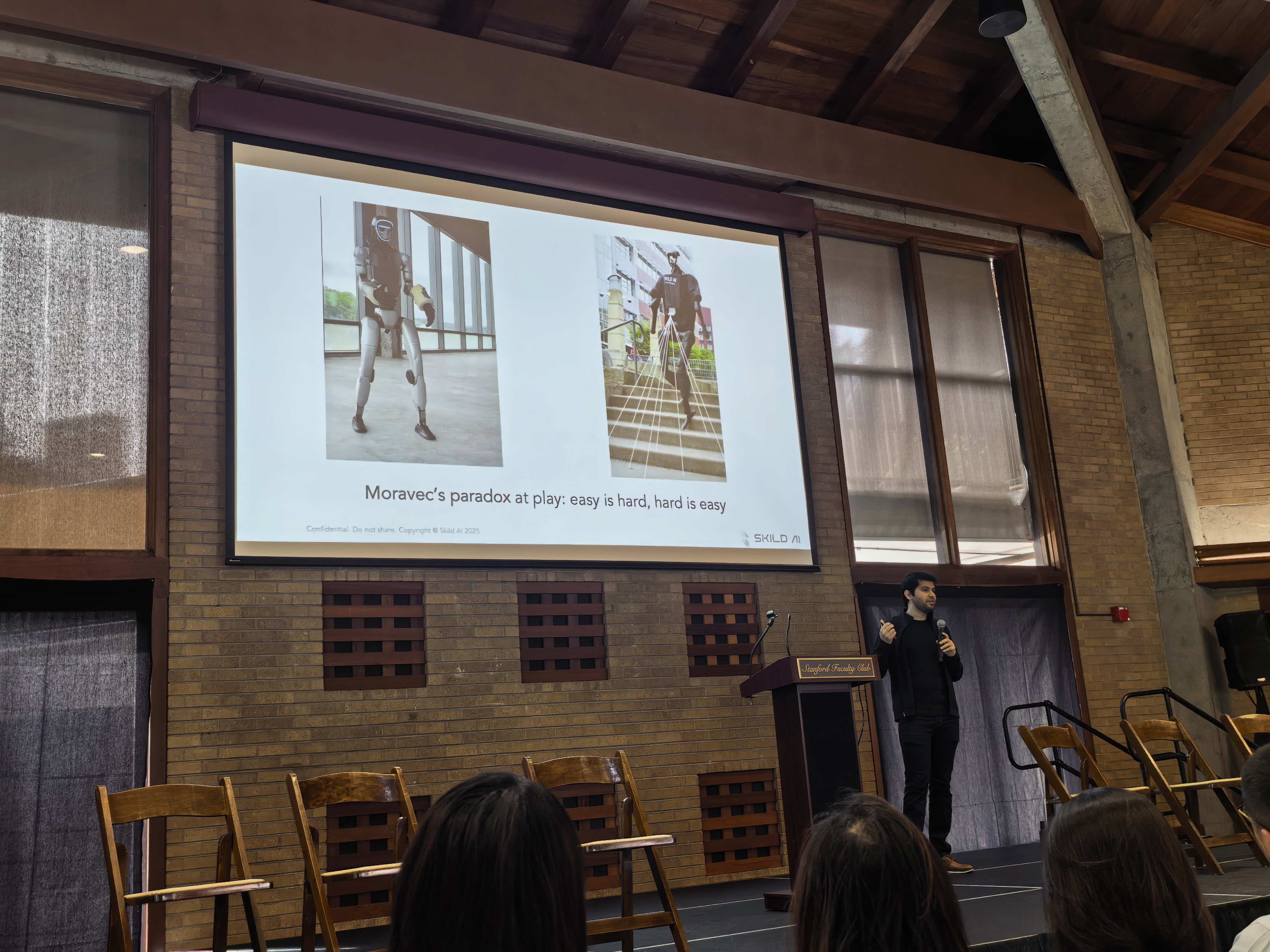
Which is harder: a backflip, or walking down stairs?
The answer may be the opposite of what intuition tells us.
For humans, walking down stairs hardly requires conscious thought. Before taking the next step, we do not calculate step height, floor friction, or the center of gravity of our body. A backflip, by contrast, requires specialized training. Many people will never try one in their lives.
For robots, the situation is reversed. Flips can be trained and reproduced in a designed environment. Put a robot on an ordinary staircase, and it may immediately encounter a world it does not yet understand.
A Backflip Is a Demo. Walking Down Stairs Is the World.
At the summit, I met researchers from Stanford and Carnegie Mellon, as well as teams building embodied intelligence companies. The interesting part of the question from Skild AI is not the comparison between two movements. It is that the question separates demo capability from real-world capability.
We have seen many impressive robot videos: front flips, backflips, side flips, and cleanly executed athletic moves. These moves certainly involve technical depth, but they often happen in relatively open, stable, and prepared environments. Obstacles are designed in advance, actions are tuned repeatedly, and the robot knows the angle of each joint and the torque each motor can generate.
In that kind of environment, once the robot has trained a set of joint movements, it can perform an impressive routine. After that, the same routine can be repeated again and again.
The problem is that the real world does not prepare the environment and wait for the robot to enter.
A Carpet Turns the Problem Into a Different Problem
A standardized staircase may not look difficult. But once the robot enters a real environment, the width, height, and material of each stairway may be different. Some stairs are wood, some are concrete, some are covered with tile, and each surface creates a different kind of friction.
Add a carpet, and the problem changes again. Add a few objects on the stairs, and the robot may slip when it lands. Humans adjust stride length, speed, and balance almost without thinking. For a robot, this means continuously capturing the scene through cameras, running computer vision, and passing the results into the body's motion control system.
So the real difficulty is not whether a robot can walk down stairs once. The difficulty is whether it can transfer what it has learned across different staircases.
In the video, Lincoln used a precise line:
It does not yet have the cross-scenario capability humans expect.
That sentence is worth sitting with. Many human capabilities look simple not because they are simple, but because we have already compressed enormous amounts of perception, judgment, and motor control through years of everyday life. We experience that complexity as a nearly automatic daily action.
Robots have not completed that compression yet.
Easy Is Hard, Hard Is Easy
The less controllable the environment becomes, the more computation a robot needs to handle. It must not only see the stairs; it must understand the structure, material, friction, and possible obstacles, then translate that understanding into concrete movement for every step.
At the Stanford AGI Summit, Lincoln heard a phrase that captures this pattern:
easy is hard, hard is easy.
This is not just a clever line about robots. It is a recurring pattern in AI and robotics. Tasks that require focused training for humans, with clear action boundaries, can often be mastered by machines through data and control systems. Tasks humans learn naturally from childhood inside complex environments often contain too much implicit judgment, making them the hardest capabilities for machines to reproduce.
That is why there is still a long distance between completing something once in the lab and doing it continuously in the real world.
Don't Be Convinced by the Demo Too Quickly
This matters especially for entrepreneurs and investors. When evaluating a robotics company, it is easy to be impressed by a smooth demo. The robot can run, jump, pick things up, and move with a level of polish that looks almost beyond human.
But the better the demo looks, the more important it becomes to ask several questions. Does the action only work in a pre-arranged environment? What happens if the surface, lighting, or object position changes? If the robot fails, can it collect data, explain the cause, and become better the next time?
Lincoln's reminder was direct:
Do not be misled by flashy demos.
The real question is whether the robot can help people solve real problems, and what advantage it has compared with humans.
That advantage may come from cost, or from endurance. A person can work eight to ten hours a day. A machine can work twenty-four hours. A person may not want to enter a dangerous environment. A machine can take on high-risk actions. A robot is not valuable because it looks like a human. It is valuable when it can be more stable, more durable, or safer than humans in a specific task.
A Home Is Not a Standardized Factory
Many people want robots to enter homes quickly: doing chores, taking care of children, walking the dog. The desire is understandable, but the home is one of the most complex application environments.
Every home has different furniture standards. The floor may have cables, pets, cleaning robots, and objects that move from day to day. Some homes are tidy; others are constantly changing. For a robot to understand, integrate with, and create value inside these non-standard homes is much harder than completing a repeatable action on a standardized production line.
This is why many embodied intelligence experts believe it will still take a long time for robots to truly enter the home. The issue is not that robots cannot do any movement. The issue is that the home has no clear rulebook, and it rarely gives the robot a stage where everything can be rehearsed in advance.
Failure Data Is More Valuable Than a Successful Performance
When studying a robotics team, we should not only look at their most successful video. We should also look at the failures they encountered during research and development.
After a demo fails, does the team record the field data? Can they tell whether the issue came from perception, the algorithm, or motion control? How do they feed that failure back into the system and improve the next iteration?
These questions reveal more about a company's real capability than whether it can complete a backflip. Ultimately, a robot will not face one performance. It will face countless uncertain interactions. It must gain new information from failure, rather than hiding failure outside the demo.
From this perspective, a robotics company's core asset is not only hardware, and not only a beautiful movement. Its core asset is the ability to continuously turn real-world failure into better perception, judgment, and control.
Final Thoughts
Robot performances have value. A backflip can show that body control, mechanical structure, and algorithmic training have reached a certain level. But performance is not the core value of building robots.
Performance is not the core value of building robots.
The real test is what happens when the robot leaves the lab, walks onto a staircase made of unfamiliar material, enters a home where every piece of furniture is different, and faces a cable that suddenly appears or a pet that runs past. Can it still do well the things humans consider simple?
That is the entrepreneurial reminder behind "easy is hard, hard is easy." Do not only ask whether a machine can perform an astonishing move. Ask whether it can create stable value in an uncertain world. When robots can truly do these ordinary things better than humans, we will begin to enjoy the real benefit of robots entering the human world.
About MindsLeap
MindsLeap is an AI-native organization transformation acceleration platform.
Through deep collaboration with the Silicon Valley innovation incubator Founders Space, MindsLeap connects global AI frontier thinking, the Silicon Valley technology startup ecosystem, and real transformation scenarios for Chinese entrepreneurs.
Around AI-native organization building, MindsLeap is developing a transformation ecosystem for entrepreneurs, founders, AI engineers, industry experts, and investors, helping companies turn AI from awareness, strategy, and tools into organizational capability, business workflows, product innovation, and growth systems.
This article was translated and adapted from the Chinese original with AI assistance.