Author: Lincoln Wang | Founder & CEO, MindsLeap | Partner and CEO, Founders Space China | Founder, MindsLeap Founders AI Club
Now may be the best time in the world to build a startup.
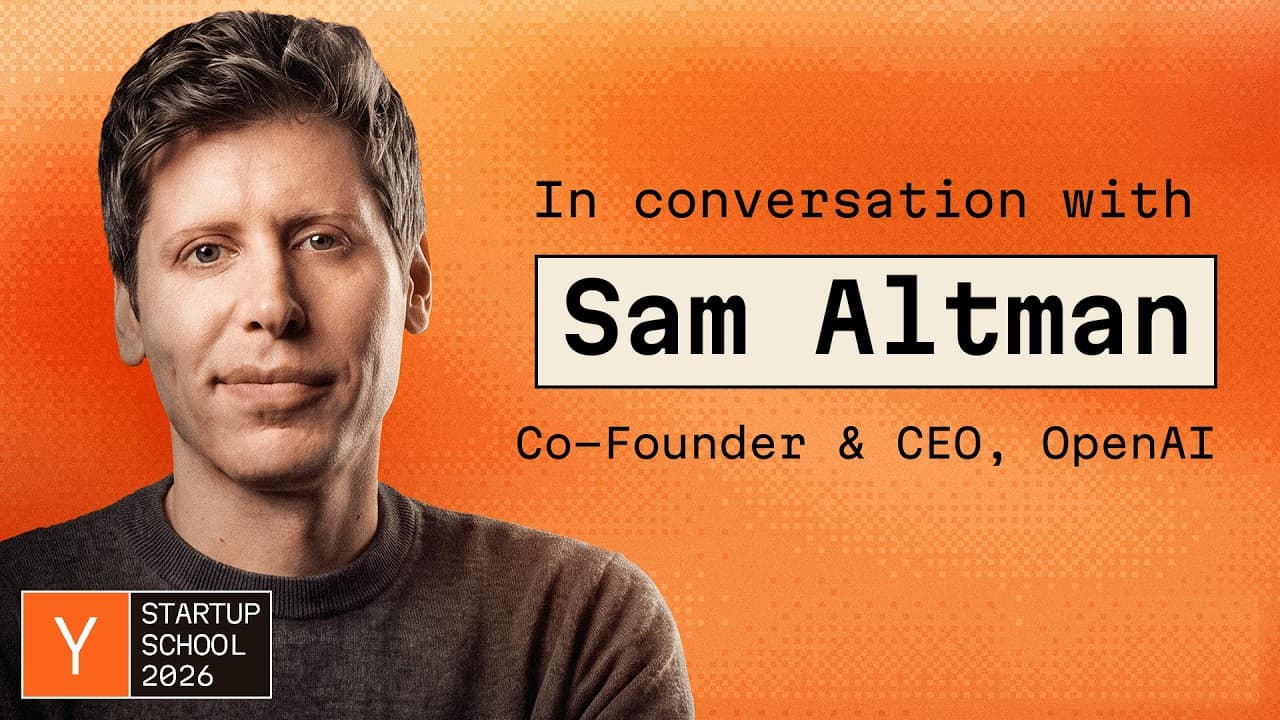
That was Sam Altman's direct message on stage at YC Startup School. Taken alone, it sounds like a motivational line for founders. What made it interesting was that he did not begin with OpenAI's grand narrative. He began with a small house in 2005.
That year, Sam was a sophomore at Stanford and joined the first batch of Y Combinator. Startups were not cool. A few young people gathered in a house in Cambridge, and Paul Graham cooked for them every week. Sam recalled that what a team could build in three months back then might be done by a coding agent in seven minutes today.
The shift behind that sentence is much bigger than “coding faster.”
Belief Created over Dinner
Sam's memory of Paul Graham is not about a business framework. It is about a very simple capability: sending a group of young founders who were about to lose confidence back into the fight.
He said everyone would arrive at dinner feeling desperate. By the time they left, Paul Graham had somehow made each person believe their company could become the next Google or Facebook.
He could create optimism, momentum, and belief from nothing.
Founders should think about that sentence carefully. What early-stage startups lack most is often not tools, but belief. Not blind belief, but the ability to keep pushing something forward when information is scarce, resources are limited, and the outside world does not yet believe.
AI changes the cost of tools, but it does not remove this requirement. It simply makes the lever for “pushing forward” suddenly much longer.
Seven Minutes for Three Months of Work
Sam said founders today can respond in two ways.
One response is discouragement: if a Codex prompt can seemingly turn into a startup, what is left for me? The other response is excitement: if the basic infrastructure has changed this much, can I now build a company that would have been impossible before?
His answer is the second.
You can build the most ambitious and outrageous company in the world.
Why? Because the capability boundary available to startups has changed. You are no longer just hiring a few engineers and slowly stacking product. You can amplify expert capabilities across multiple domains with AI. You can compress work that used to require large teams, large budgets, and heavy organizational coordination into a smaller and faster team.
This is why I think this conversation is worth writing about. It is not saying startups have become easy. It is saying the scale of problems startups can responsibly attempt has become larger.
In Technology Shifts, Giants Also Hesitate
Sam mentioned that technological turning points always create opportunities for startups. Large companies have resources, but they also have path dependence. They naturally protect existing businesses, existing workflows, and existing organizational structures. Startups do not carry those burdens.
This does not mean large companies will lose. AI is unusual because it is an augmenting technology, and many foundational capabilities will still be controlled by major platforms. But for startups, the real opportunity is not to compete with giants on compute. It is to find problems that were previously unsolved because the organizational complexity was too high.
In the past, a small team could only build small products. Today, if a small team has dense enough judgment, it can take on more complex workflows, more specialized vertical scenarios, and business processes that traditional software could never fully absorb.
That is the opportunity for super individuals and super small teams.
Do Not Just Build Cheaper Software
Sam repeatedly emphasized the word ambitious. That word matters because it differs from how many people currently think about AI startups.
Many AI products still remain at the level of making old labor workflows cheaper: cheaper customer service, cheaper copywriting, cheaper outsourcing, cheaper code. But if the only value is cheapness, it will quickly be chased down by cheaper models, cheaper tools, and cheaper competitors.
The real question is this: can you use AI to redefine how work is done inside an industry? Entrepreneurs should not only ask whether AI can reduce costs by 30%. They should ask whether there is a class of problems in their company or industry that has never been solved well because coordination cost was too high, expertise threshold was too high, or feedback loops were too slow.
If AI agents can become new units of execution, can those problems finally be reopened?
People Still Matter Most
One part of the conversation is easy to overlook. When Sam talked about the early days of OpenAI, he did not frame the story as “I saw AGI, therefore I won.” He talked about finding a group of people willing to believe in the same thing.
When the outside world did not believe in AGI, and even thought the idea was absurd, what was truly scarce was shared belief.
This is highly relevant for entrepreneurs today. The AI era does not make people unimportant. It shifts the importance of people from “how many tasks they execute” to “what they believe, what they judge, and what they organize.”
Tools will keep getting stronger. But tools will not decide for you what is worth doing.
Final Thoughts
When Sam Altman returned to the YC stage, he was essentially reminding founders of one thing: AI does not only lower the barrier to starting a company. It also raises the ceiling of what a startup can become.
These two things are happening at the same time. That is the biggest change. If we only see the lower barrier, we will get many cheaper, faster, shorter-lived products. If we see the higher ceiling, we will start asking a more serious question: can a ten-person team take on a problem that previously belonged only to a hundred-person or five-hundred-person company?
I have long believed that the AI era will produce two kinds of organizations: super organizations and super individuals, while the middle layer gets squeezed. Sam's talk pushes that judgment one step further.
The most important thing to watch may not be whether AI helps founders hire fewer people. It may be whether founders can ask a bigger question from day one: can I use a small team to solve a problem that used to belong only to large companies?
About MindsLeap
MindsLeap is an AI-native organization transformation accelerator.
In deep partnership with Silicon Valley innovation incubator Founders Space, we continuously connect cutting-edge global AI insights, the Silicon Valley tech entrepreneurship ecosystem, and real transformation scenarios for Chinese entrepreneurs.
Around the theme of AI-native organization building, MindsLeap is constructing an ecosystem for entrepreneurs, startup founders, AI engineers, industry experts, and investors — helping enterprises move AI from cognition, strategy, and tools into real organizational capabilities, business processes, product innovation, and growth systems.
This article was translated and adapted from the Chinese original with AI assistance.